
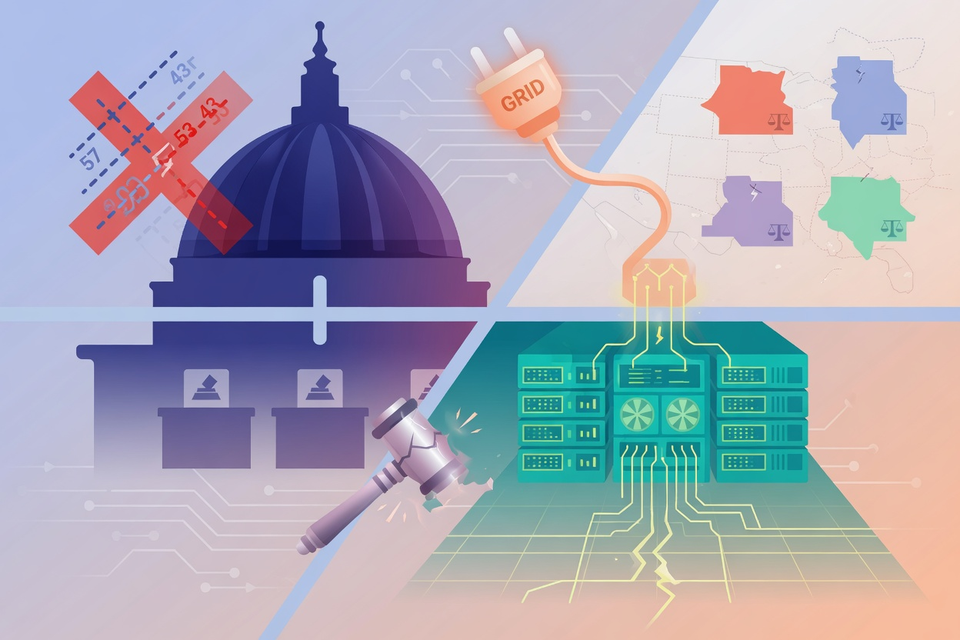
The Senate fell three votes short of taking up the Ratepayer Protection Act, with cloture on the motion to proceed to H.R. 9340 rejected 57 to 43 against the 60 required, according to the Senate's roll call record. The House had passed the identical bill 417 to 3 on September 16, so the question for anyone planning a large grid connection is why it stalled, and what that leaves in place.
At two pages, the bill is short. It would add a standard to section 111(d) of the Public Utility Regulatory Policies Act of 1978, the federal law that tells state regulators which ratemaking practices they must weigh. A rate for a large-load customer would have to recover the full, incremental cost of any generation, transmission or distribution upgrade needed to serve that load, including if the customer later terminates its contract, and the utility would have to collect financial assurances before building. A large-load customer is a non-residential consumer running primarily information technology infrastructure for data storage and computing with a peak demand of 100 megawatts or more at a single site or campus.
One word decided the vote: consider. PURPA standards are not mandates. The text directs each state regulatory authority and nonregulated utility to begin considering the standard within one year of enactment and to decide within two, and it exempts states that have already implemented or formally considered a comparable one. Minority Leader Chuck Schumer, in floor remarks published by his office, said, "I can sum up the shortcomings of Republicans’ data center bill with one word: optional." He added, "A guardrail that is optional isn’t a guardrail at all."
Sen. Martin Heinrich of New Mexico, the ranking Democrat on the Energy and Natural Resources Committee, said in a statement after the vote, "The Ratepayer Protection Act is exactly what Congress is known for: all message and no substance. If voluntary pledges and suggestions worked, families and small businesses wouldn’t be staring down rate hikes right now." Heinrich had objected on September 17 when the sponsor, Sen. Jon Husted of Ohio, sought passage by unanimous consent, offering his own GRID Savings Act instead; Sen. Bernie Moreno of Ohio objected to that, according to Heinrich's office.
Husted's case, from his floor speech as published by his office: "It’s clear that big tech should be paying their own way, not passing the cost on to local communities and states." Cosponsor Sen. John Hoeven of North Dakota put it in household terms. "American families shouldn’t have to pay higher energy costs if a data center is built in their community," said Hoeven.
Four Democrats voted to proceed: Maggie Hassan, Amy Klobuchar, Jon Ossoff and Raphael Warnock, per the roll call. CBS News reports that Husted is in a competitive race against former Sen. Sherrod Brown and that the vote came weeks before the midterm elections.
What this leaves in place is the status quo: no federal standard on who pays for large-load upgrades and no federal clock forcing states to set one. Large-load tariffs, collateral requirements and minimum-take terms continue to be set state by state and utility by utility.
For a buyer sizing a campus above 100 megawatts, the terms that decide who pays for a new substation or transmission tie still come from the state commission and the utility's large-load tariff, and the cost-recovery, collateral and exit provisions in this bill are a fair preview of what those tariffs increasingly ask for. Engineers building interconnection schedules should plan on that patchwork persisting, because the bill cannot move without 60 Senate votes it did not have.


Leave a Reply