
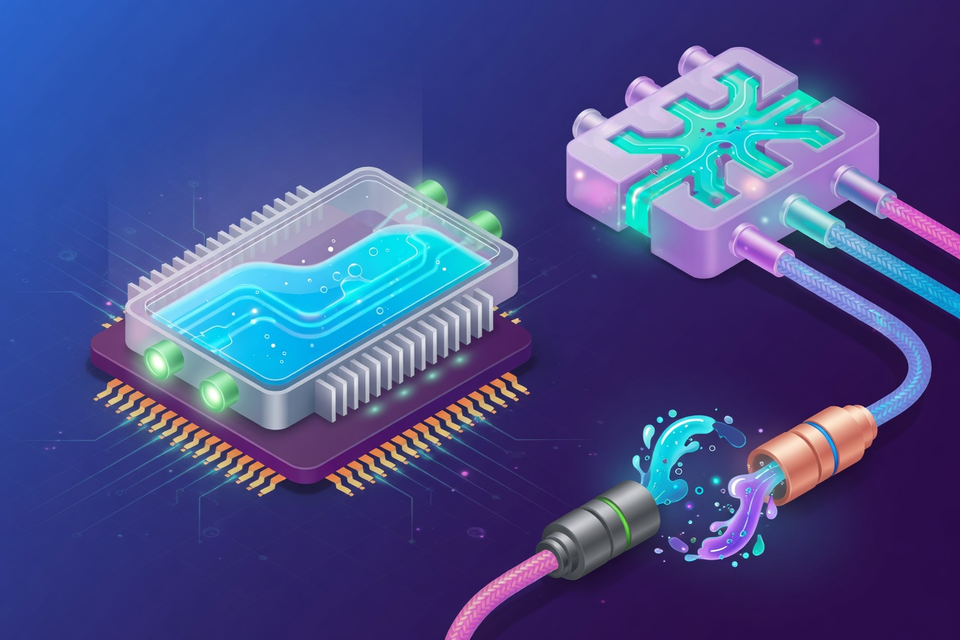
UL Solutions has launched a certification program for the liquid-filled parts that carry coolant to and from processors in direct-to-chip cooling systems. The program is available now, according to the company's release, and it evaluates cold plates, manifolds and quick disconnects against UL 4501, an outline of investigation titled Safety, Performance and Interoperability of Liquid-Filled Components and Assemblies Used in Liquid Cooling Systems.
The evaluation covers coolant compatibility, pressure and leak integrity, durability, liquid flow, interoperability, production controls and installation requirements. Certification applies to subassemblies rather than complete systems. The release describes cold plates that draw heat directly from the chip, manifolds that distribute coolant to servers and racks, and quick disconnects that let equipment be serviced without draining the full cooling system.
Integration is the problem it is aimed at. Parts from different suppliers may fit together and still require different coolants, pressure levels or operating conditions, the release says, and it points to integration problems and limited standards as the barriers industry observers have identified to wider use of liquid cooling. Leaks, corrosion, contamination and parts that do not work well together are the failure modes it names.
“As AI data centers handle more powerful computing, they depend on even more advanced cooling systems to operate safely and reliably,” said Jennifer Scanlon, president and CEO of UL Solutions. “Our certification helps IT equipment manufacturers demonstrate product performance and safety while giving data center operators greater confidence during integration.”
What the release does not say is what an evaluation costs, how long it takes, or whether any manufacturer has enrolled or received a certification. Nor does it name a first certified product. Those are the details a buyer would need before writing UL 4501 into a purchase specification, and none of them is public.
Scope matters for anyone assembling a loop from several vendors. UL Solutions says it can also evaluate coolant distribution units, self-contained liquid-filled systems, liquid-cooled busways, cables, connectors, power whips, gaskets, O-rings and hoses under other applicable UL standards, with requirements depending on each product's design, function and intended use. A certified cold plate does not certify the distribution unit upstream of it; each part sits under its own evaluation.
“AI infrastructure must scale without sacrificing safety or reliability,” said Milan Dotlich, vice president and general manager of Data Center Solutions at UL Solutions. “Independent evaluation of liquid cooling components can help organizations deploy advanced computing systems with greater confidence.”
The release also carries two market figures that are not UL Solutions' own measurements: that global data center electricity use is expected to more than double between 2024 and 2030, and that cooling can account for up to 40% of a data center's energy use. The release links the first to an International Energy Agency report and the second to a U.S. Department of Energy article; both describe the market rather than the program.
For a buyer, a UL 4501 mark on a cold plate or quick disconnect is a third-party answer to the interoperability question that vendor spec sheets currently leave to the integrator. Whether it changes procurement depends on which manufacturers submit parts and how quickly certified listings appear, neither of which UL Solutions has disclosed.


Leave a Reply