
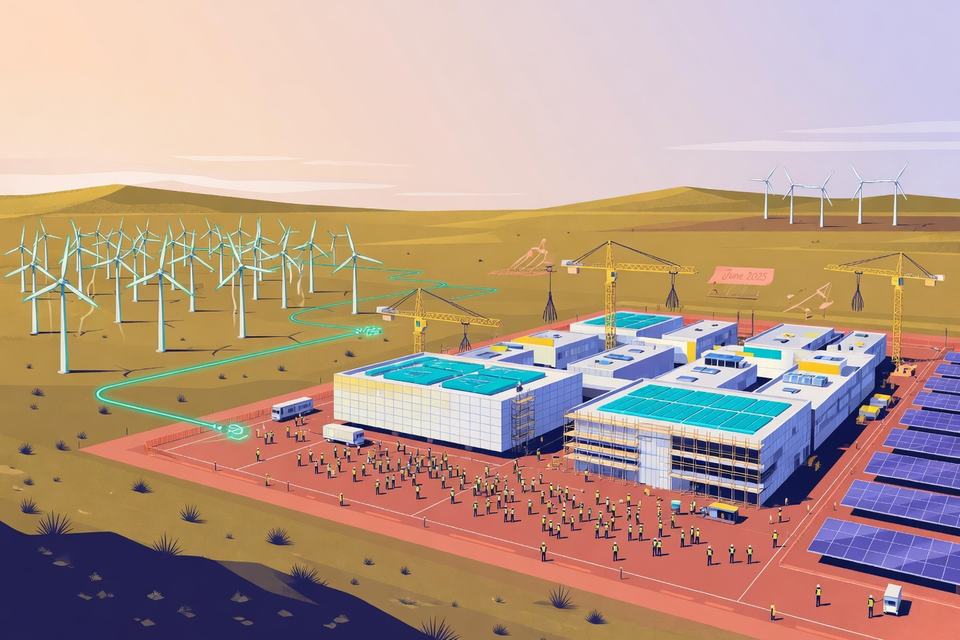
Crusoe has confirmed that it is the developer of the Google data center campus under construction in Armstrong County, Texas, outside Amarillo, in a release that puts the groundbreaking at June 2025 and the current workforce at more than 5,500 people on site each day. The pairing is not news locally: KVII, Amarillo's ABC affiliate, reported in November 2025 that Google would be the tenant of a campus on 1,300 acres near Claude that Crusoe had been building since that May. What is new is Crusoe putting its own name to the project and describing how it is powered and cooled.
Power comes first in the release. The campus has a direct connection to two adjacent wind farms owned by Serena: Goodnight 1, rated at 265.5 MW and operating, and Goodnight 2, also 265.5 MW, under construction and described by Crusoe as catalyzed by its development at the site. That is 531 MW of nameplate wind by this desk's arithmetic. When generation exceeds campus demand, surplus is exported to the grid. The release does not give the campus's own IT capacity, its number of buildings, or what it draws from the grid when the wind is not blowing; in KVII's 2025 report, Armstrong County Judge Adam Ensey said the site would pull from the ERCOT grid even though the Panhandle sits in the Southwest Power Pool.
"Building the future of AI requires a new kind of infrastructure, starting with energy. Crusoe’s strategy is to build AI factories directly at the source of abundant, low-cost energy – to both improve utilization of existing assets as well as catalyze new energy generation," said Chase Lochmiller, Crusoe's chief executive and co-founder. The detail that sentence glosses over is firm supply: a campus wired to a wind farm still needs power when the turbines are idle, and the release names neither a battery nor a gas plant nor a grid contract.
Cooling is the second design choice. The campus uses a closed-loop, non-evaporative liquid cooling system that Crusoe says limits the water footprint mainly to domestic uses such as kitchens. For a facilities engineer, a closed loop rejects heat to air rather than to evaporation, which moves the cost from water to fan and chiller energy in Panhandle summers; the release publishes no PUE or WUE figure to weigh that trade against.
Lochmiller framed the site as a repeat of the company's Abilene work. "The Armstrong County campus is a prime example of this energy-first strategy. We're bringing new, affordable clean energy online. We broke ground in June 2025 and are building at the same swift pace we set in Abilene." Crusoe now has two campuses under development in Abilene alongside this one, and as this desk reported when the company closed its $3.9 billion Series F, it claims more than 6 gigawatts of gross contracted capacity with roughly 1 gigawatt operational. The release gives no completion date; KVII's 2025 report put it at late 2028 or early 2029.
The community side is running in parallel. KVII reported last week that Google and Crusoe held an open house at Claude High School for a project residents know as Project Llano, where some residents said they remained uneasy about its effect on their land. Crusoe's release notes that Google's Energy Impact Fund has announced support for efficiency upgrades to public buildings and homes in the county.
For buyers and engineers, the notable choice here is siting compute at a wind farm's terminals with a closed cooling loop, which trades water use for energy cost and grid exposure. Anyone benchmarking a West Texas build against it will want the figures the release omits: the campus's IT capacity, its firm supply when the wind drops, and a commissioning date.




Leave a Reply