
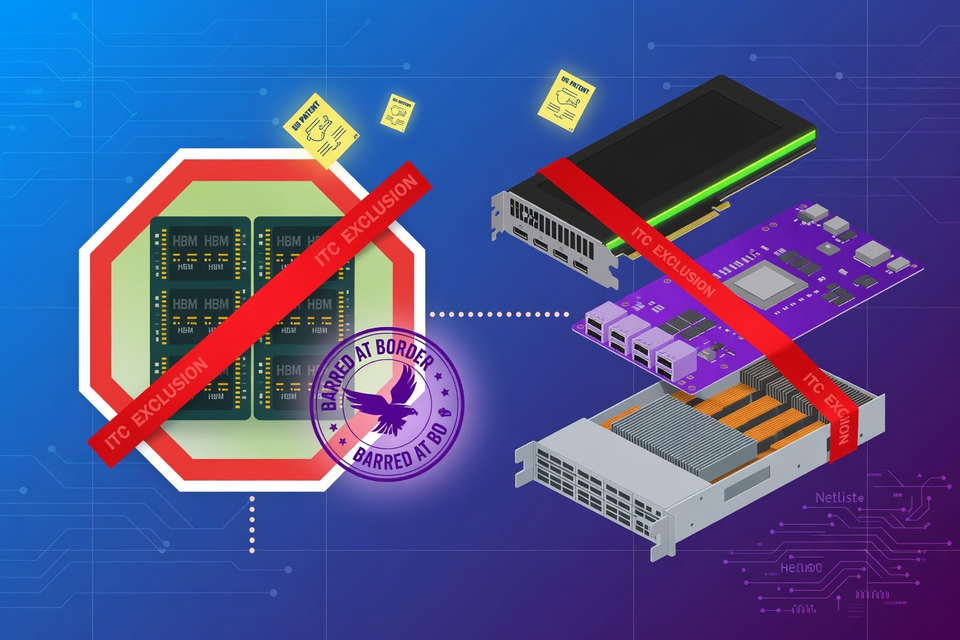
Netlist has asked the United States International Trade Commission to stop Micron's high bandwidth memory at the border, and it wants the Nvidia, Broadcom and Google hardware built around those chips held up with it. Netlist announced the complaint in a release distributed through PR Newswire, and it is the company's second trip to the commission against Micron in seven weeks.
A word on the venue, because it matters more than the acronym suggests. The ITC, said letter by letter, is a federal agency that polices unfair imports. It cannot award a dollar of damages. What it can do is issue an exclusion order, which tells customs officers to stop goods at the port, and a cease and desist order, which tells the importer to stop selling what is already in the warehouse. Think of it as a bouncer rather than a judge, and a quick one: in an earlier release Netlist says ITC cases commonly progress to trial within a year.
The memory at issue is HBM, also said letter by letter. Picture DRAM chips stacked straight up like floors in a tower and parked right next to the processor so the data has a short commute. That is the memory feeding AI accelerators, which is why the complaint reaches past Micron to the companies that buy its stacks. Netlist alleges that U.S. Patent Nos. 12,308,087 and 12,646,537 cover at least Micron's HBM3E, HBM4 and HBM4E products, and it names Nvidia, Broadcom and Google as downstream customers and respondents alongside Micron.
C.K. Hong, Netlist's chief executive, said, "Netlist has spent decades developing advanced memory technologies now used in rapidly expanding AI infrastructure. This action reflects our continued commitment to protecting our foundational technologies from unauthorized use."
Reuters reports, in wire text carried by KFGO, that the complaint was first filed under seal on Friday, that Micron declined to comment, and that spokespeople for Google, Nvidia and Broadcom did not immediately respond to requests for comment. Reuters' text also recalls that Netlist won a $445 million patent verdict against Micron in a Marshall, Texas, federal court in 2024, and that it settled a separate memory-patent dispute with Samsung in August after winning $421 million in verdicts against Samsung in the same court.
That Samsung deal tells you what Netlist is playing for. When the commission instituted its August complaint, Hong said, "The Samsung agreement established an important industry benchmark for the value of our IP." That first case, filed on August 11 and instituted as Investigation 337-TA-1523 on September 23, concerns DDR5 RDIMMs and MRDIMMs, the memory modules that plug into ordinary servers, and names Super Micro Computer, Hewlett Packard Enterprise and Lenovo. The new one climbs the value chain to the accelerators themselves.
Micron, for its part, is collecting patent fights the way I collect unread datasheets. This desk covered a Munich court's injunctions over YMTC's utility models only days ago; that dispute is about 3D NAND and comes from a rival manufacturer in a German court, while this one is about HBM and comes from a licensing company that trades over the counter, in a forum that can stop shipments rather than award money. Different plaintiff, different forum, same defendant.
What happens next is procedural but not slow. The commission decides whether to institute an investigation, as it did in September on the first complaint, and if it does, Netlist's own calendar runs to a trial inside a year. Until then, the stacks keep shipping.




Leave a Reply