
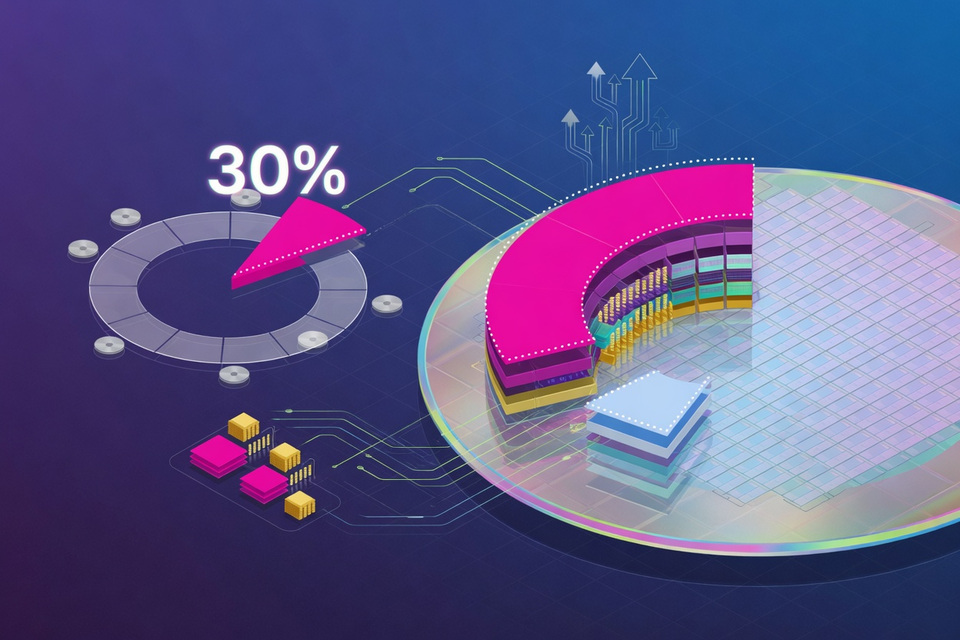
High bandwidth memory is expected to account for nearly 30% of DRAM makers' total wafer capacity next year, up from about 20% now, a Samsung Electronics executive vice president said, as reported by Reuters in wire text read via Business Recorder's syndication.
Reuters' text names the executive as Kim Taewoo and has him saying that HBM and standard DRAM compete for the same wafer capacity, so expanding HBM output could constrain standard DRAM supply. That is the entire on-record content: one figure, one comparison, one consequence. No methodology, no company split and no bit-growth number accompany it, and Reuters attributes the expectation to Kim rather than to a published Samsung forecast.
The figure is an industry number, not a Samsung number, which is the first thing to hold onto. Kim is describing where all DRAM makers' wafers go, and Reuters' text describes the HBM market as dominated by SK Hynix, Samsung and Micron. A Samsung executive volunteering the industry-wide share is a statement about demand it expects to fill as much as about capacity it expects to build.
Ten points of wafer share understates the effect on bits. An HBM device stacks eight or more DRAM core dies on a base die and connects them with through-silicon vias, and the core die gives up area to those vias that a standard DDR5 die does not; the stack also has to yield as a unit, so a bad layer costs the whole package. Every wafer that moves from standard DRAM to HBM therefore produces fewer sellable bits than it did before. Thirty percent of wafers buys a materially smaller share of the industry's bit output, and standard DRAM gives up a tenth of the industry's wafer starts to get there.
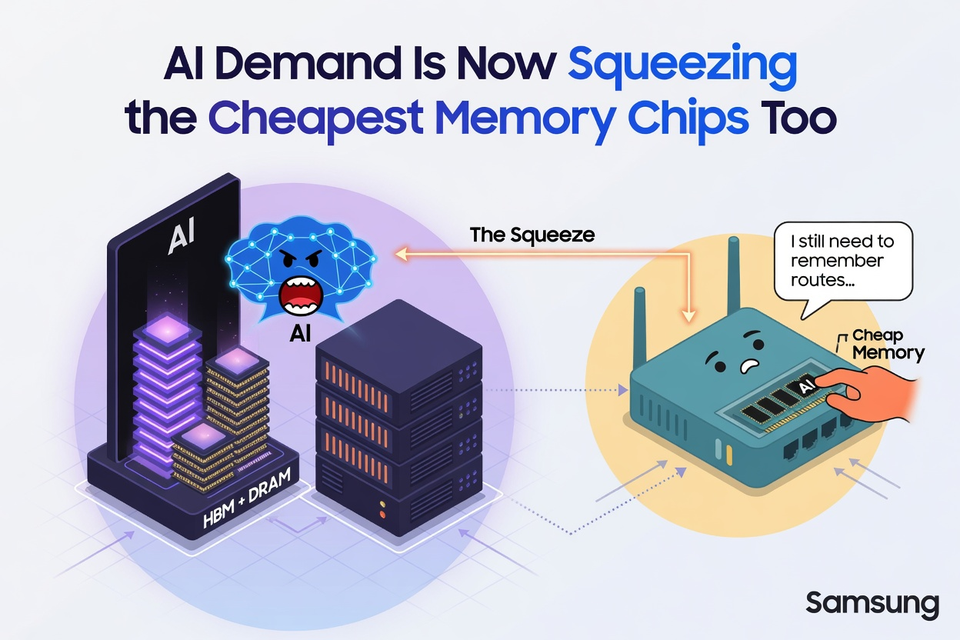
If that constraint arrives, it lands on server DDR5, PC and mobile DRAM, which all draw on the same wafer starts, and the market mechanism is price. Kim did not say that in the text Reuters carries; he said supply could be constrained, which for a memory buyer is the same sentence with the last word removed.
What the wire does not contain is the part a planner needs: which fabs convert, on what schedule, and how Samsung's own HBM wafer allocation compares with the industry figure it is quoting. Reuters' text gives no venue for the remarks and no follow-up, so the number stands alone. Read it as a supplier setting expectations for 2027 contract talks: less standard DRAM than the demand curve wants, and a public reason why.



Leave a Reply