
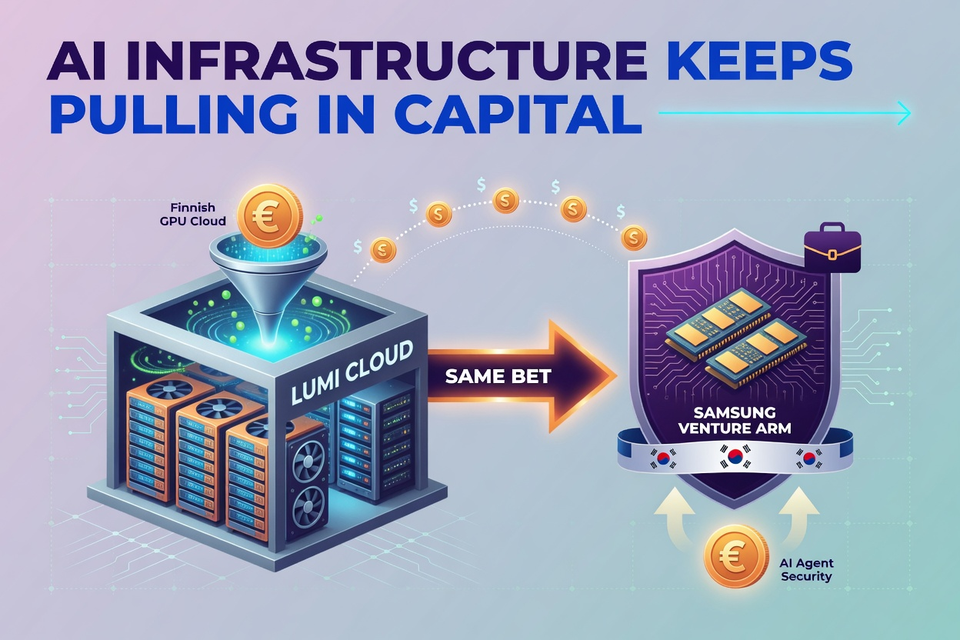
Five funding announcements this week traced the same line: money is still moving toward companies that either build AI infrastructure or defend it. The rounds ranged from a Finnish GPU cloud operator to a Korean memory maker's new venture arm, and together they show investors treating compute capacity and AI agent security as two sides of the same bet.
Verda, the Helsinki company formerly known as DataCrunch, raised $189 million in a Series B led by Emergence Capital, with Super Micro Computer, MUFG Innovation Partners and Finland's state investor Tesi among the other backers. The round pushed Verda past a $1 billion valuation, though the company has not disclosed an exact figure. Its annualized revenue run rate reached $165 million in July, up from more than $60 million in April, and it plans to expand computing capacity several times over within a year. Ruben Bryon, Verda's founder and chief executive, said, "AI is becoming critical infrastructure across industries, and the next few years are a pivotal window for Europe."
Healthcare AI drew its own round. Heidi, the Melbourne startup whose software automates clinical documentation, closed $340 million, doubling its valuation to $900 million from the $465 million it carried after last October's Series B. Only $100 million of that is equity, led by existing investor Blackbird; the remaining $240 million comes from General Catalyst's Customer Value Fund, a revenue-based instrument that takes no equity stake. Heidi says its product now supports more than 175 million patient visits, up from 73 million a year ago. Heidi cofounder Dr. Thomas Kelly said, "From the day I started Heidi, the ambition was always bigger than writing doctor’s notes."
On the security side, Cyera pulled in a further $400 million from Goldman Sachs Alternatives, extending a Series G that has now raised more than $2 billion without assigning the company a new valuation above its existing $12 billion mark. The Israeli firm builds tools that track what corporate data AI agents can see and touch, a problem conventional access controls were not built to handle. Cyera cofounder and chief executive Yotam Segev said, "AI infrastructure is moving faster than the security architecture around it."
Regulated industries got their own infusion. Go.AI, a Chicago company selling on-premises AI hardware and software to regulated industries such as banking, healthcare and defense, raised $85 million in a Series A led by Updata Partners, bringing its total funding to $90 million. The company says annual recurring revenue is up more than eightfold year over year across more than 200 customers, whose deployments together process over 12.5 million queries a day.
Corporate venture capital expanded too. SK hynix used its first Silicon Valley "Ventures Day" to launch a new investment brand, SK hynix Ventures, widening its scope beyond semiconductors into AI computing, data centers, system software and optical interconnect. The company says its venture investments across the United States, China, Israel and Japan have already returned more than twice their cumulative value. "Competitiveness in the AI era stems not just from rapidly securing innovative technologies, but from ecosystem capabilities where customers, partners, and startups create new value together," said Kwak Noh-Jung, SK hynix's chief executive.


Leave a Reply