
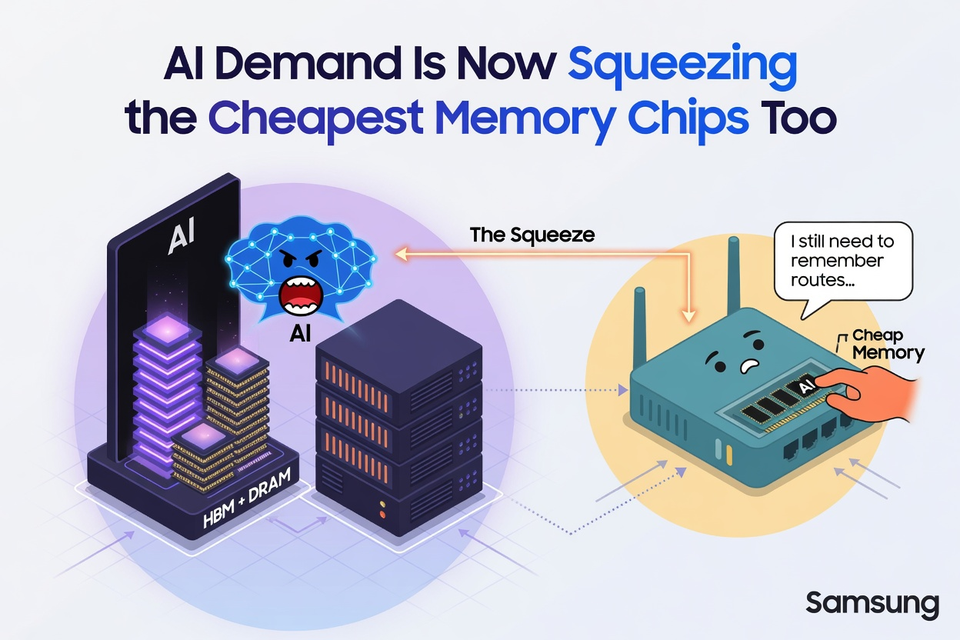
The memory shortage everyone is watching runs through HBM and DRAM, the chips inside AI accelerators and the servers around them. A quieter version of the same squeeze is hitting parts nobody thinks about: the small, cheap memory that lets a router remember it is a router.
NOR flash and single-level cell, or SLC, NAND are decades-old technology used to store boot and program code in cars, industrial equipment, networking gear and other embedded hardware built to last years. Neither shows up in headlines about GPU shortages, but both are getting squeezed as wafer capacity gets routed toward higher-margin products, Tom's Hardware reports. Contract prices for NOR flash and SLC NAND rose more than 100 percent in the first half of 2026, according to TrendForce figures reported by Tom's Hardware. TrendForce expects SLC NAND prices to climb another 120 to 170 percent in the second half compared with the first.
"The SLC NAND market is probably under a billion dollars a year," said Jim Handy, an analyst at Objective Analysis, in an interview with Tom's Hardware Premium. That small scale discourages new investment even as demand holds. Major NAND manufacturers, including Micron, Kioxia and SK Hynix, have been shifting wafer capacity away from SLC because it earns far less than newer NAND types, Bryan Ao, a research manager at TrendForce, told Tom's Hardware Premium in the same interview series. A 12-inch wafer devoted to mainstream NAND can generate close to $20,000 in revenue, Ao estimated, against $6,000 to $8,000 for the same wafer used for SLC. Equipment lead times of 12 to 15 months mean smaller SLC suppliers cannot simply add capacity to close the gap, which Ao called a "severe undersupply."
Handy traced the cause to the AI buildout directly. Nvidia, Broadcom and Marvell need enormous semiconductor manufacturing capacity for AI chips, and hyperscalers are "all trying to outspend each other," he said, so those orders move to the front of the queue. "They’re sucking up all of the wafers," Handy said, leaving NOR flash and SLC producers struggling to get wafers and forcing prices up in response.
There is little relief in sight. TrendForce says no significant capacity expansion is planned for either product, and Ao does not expect prices to return to 2023 or 2024 levels within the next five years. BNP Paribas has forecast that average NAND prices could reach $279.50 per terabyte in 2026, up from $73.10 in 2025, while JPMorgan expects the broader shortage to persist for at least two more years, with buyers getting only 70 to 80 percent of what they order. Handy likened the moment to the late-1990s internet buildout, where spending outran any near-term return, adding that the outcome depends on how long hyperscalers keep racing to outspend each other. Ao put it plainly: "Pretty much we have to get used to this high price, no matter which segment of memory."



Leave a Reply