
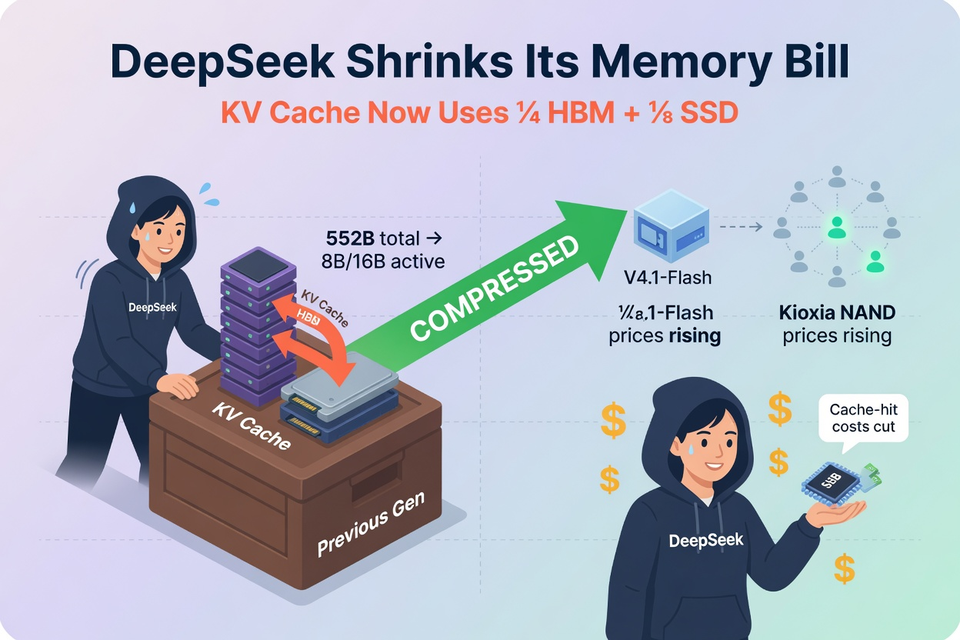
The week's most consequential memory news came from a model developer rather than a chipmaker. DeepSeek released V4.1-Flash, a 552-billion-parameter mixture-of-experts model that activates 8 billion parameters for input and 16 billion for output, and said its KV cache needs a quarter of the HBM and an eighth of the SSD storage of the previous generation. The company frames the saving in cost terms: “Cache-hit charges often account for a large share of agent costs. Compressing the cache cuts those costs significantly.”
Retirements come with it. From 04:00 UTC on September 14, 2026, requests to V4-Pro will route to V4.1-Flash at V4.1-Flash rates until a V4.1-Pro launches, and V4-Flash and its experimental vision variant are already retired. New API pricing took effect on September 10, with off-peak rates at half of peak. The efficiency figures are the company's own, and the benchmark results it cites against V4-Pro come from tests it attributes to unnamed multiple parties, so there is no independent measurement yet of either the capability claim or the memory claim.
Memory investors treated it as a demand risk regardless. Samsung Electronics and SK hynix both fell more than 3% in early Seoul trading the next session. Whether DeepSeek was the cause is not settled, because the Seoul open followed an overnight fall in all three major New York indexes on higher oil prices and Treasury yields, with technology stocks selling off, so the share moves have more than one candidate cause. The underlying question is narrower and will take longer to answer: if models cut the memory needed per unit of inference faster than usage grows, the per-unit demand driver that has carried HBM and enterprise SSD orders weakens even while total AI usage rises.
Supply-side pricing produced its own signal. Kioxia chief executive Hiroo Ota, in an interview with Bloomberg News reported via Yahoo Finance, said he has instructed his sales teams not to push data center operators for substantially higher prices, out of concern that runaway memory prices would damage investment appetite in AI, and that prices have already risen enough. He did not rule out later increases, saying the priority for now is holding prices at their current high levels, and he judged another quarter-on-quarter rise on the scale of the last one unlikely.
Ota also dismissed talk of a manufacturing tie-up with SK hynix, which holds bonds convertible into a stake in Kioxia and whose parent's chairman, Chey Tae-won, had listed such a tie-up as an option in an interview with the Asahi newspaper. Ota pointed to antitrust hurdles and to Kioxia's jointly owned fabs with Sandisk, and said the two companies are not in talks about joint production. An SK hynix representative said Chey was speaking in general terms and that no discussions are under way.
Both stories push on the same variable from opposite ends. DeepSeek is trying to lower the memory a given amount of inference requires; Kioxia is trying to keep the price of that memory from rising fast enough to choke the demand for it. If both succeed, the memory bill per unit of AI inference falls from two directions at once. Neither company has published figures that would let anyone measure by how much.


Leave a Reply