
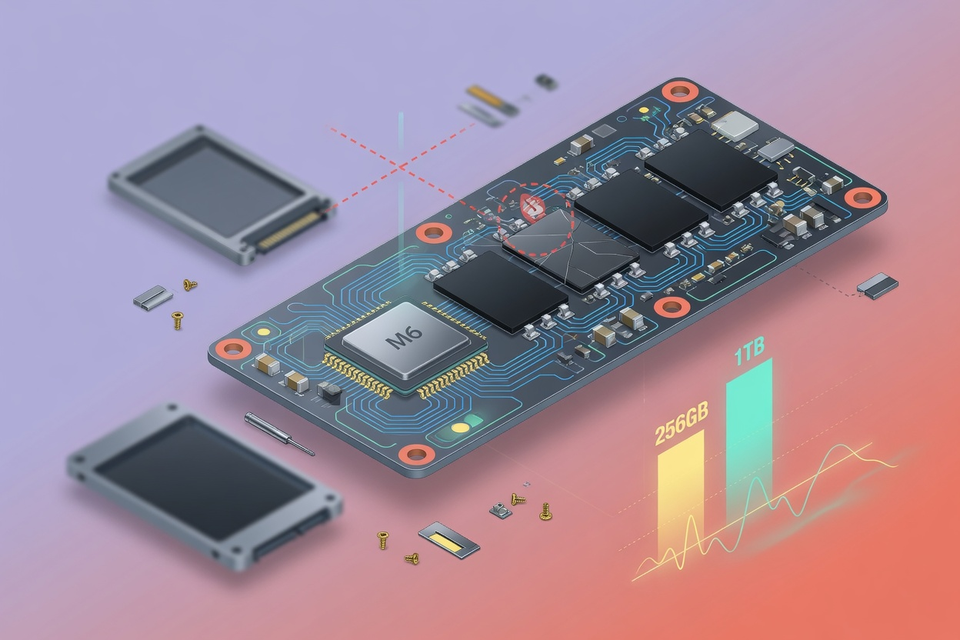
The M6 and M5 Pro Mac mini that Apple started shipping this week has its NAND soldered to the logic board, which ends the aftermarket SSD upgrade path the M4 generation opened two years ago.
Credit for the finding goes to Expand Mac mini, the small vendor that built a business selling plug-in modules for the M4 and M4 Pro machines and had every reason to open the new ones on arrival. The company wrote: “On both machines the NAND is soldered onto the logic board, as it was on the M1, M2 and M3.” Decoded, that means the M4's socketed module was the exception in the Mac mini line, not a new policy, and Apple has reverted to the design it used in every other generation. MacRumors reports Apple has not commented on the reversal.
Expand Mac mini did not dress it up: “We will keep looking for an opening, but support for the M6 and M5 Pro now looks unlikely.” It told owners of the new machines not to buy its modules because they will not fit. The economics are on Apple's price list: the M6 Mac mini starts at $899 with 256GB, configurable to 512GB, 1TB or 2TB, and the M5 Pro starts at $1,699 with 512GB. The workaround was to buy the base capacity and add a cheaper module. It is gone.
The second finding matters more for anyone sizing it for local inference. The 256GB configuration uses a single NAND package where the larger capacities use two, and that is the difference the benchmarks show. AAPL Ch., a Japanese Apple news site, ran Blackmagic Disk Speed Test on its own 256GB M6 unit and recorded 3,000.2 MB/s sequential write and 3,216.8 MB/s read. For the 512GB model AAPL Ch. relays Tom's Hardware's figures of 6,577.4 MB/s write and 6,371.5 MB/s read, so the comparison is between two testers' machines, not one bench. Apple's own marketing page promises up to 2x faster storage, with a footnote that ties the claim to a 2TB configuration.
Side by side, the base model delivers roughly half the throughput of the next tier, and MacRumors notes the 256GB M2 models had a single NAND chip too, so the M4 generation was the exception on both counts. The 256GB M6 still beats the 256GB M4, at 3,000 MB/s write against 2,014.5 MB/s in the same test, so the buyer is not losing ground against last generation, only the upgrade that made the base model worth buying.
Apple has kept the modular design where the money is. The Mac Studio with M5 Max or M5 Ultra ships with slotted SSD modules, and Apple's own repair manual for that machine reads: “SSD modules must be replaced in pairs except in devices with 512 GB, 1 TB, and 2 TB configurations, which have single SSD modules.” The same document says each module carries a serial number ending in 00 or 01 that matches its connector, that modules are specific to the Mac model, and that a swap needs a second Mac to restore the machine. Serviceable, then, but with Apple's parts, and nothing in the manual contemplates a cheaper third-party stick.
That is the shape of Apple's storage business now. The controller lives inside the M-series die, the NAND is commodity flash, and the margin sits in the gap between the two. A socketed module on the Mac mini let a small vendor arbitrage that gap for two years. Soldering the NAND closes it, and the single package on the 256GB board makes the step to 512GB the first upgrade any serious buyer will take.




Leave a Reply