
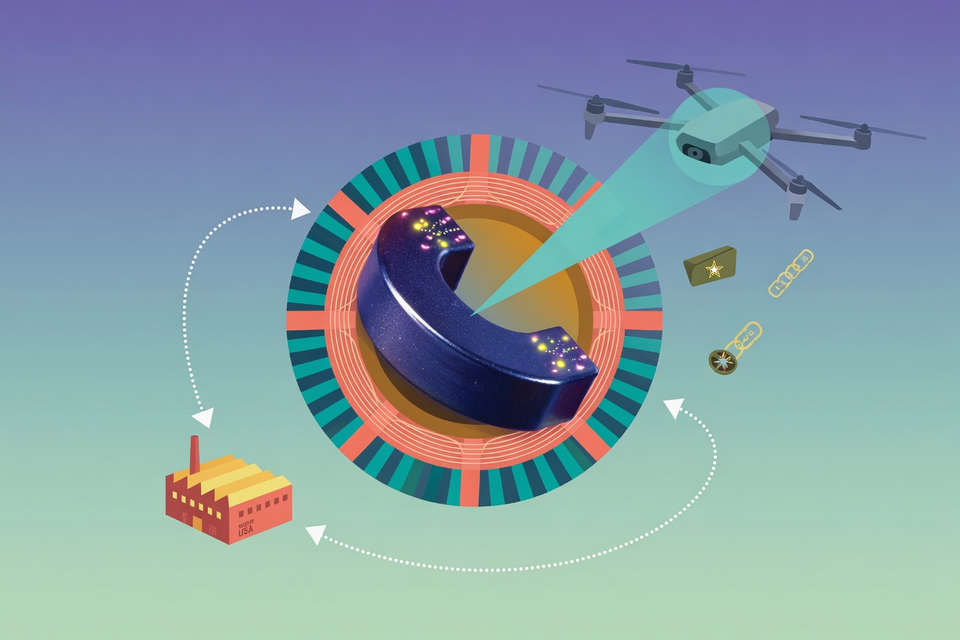
Vulcan Elements says the U.S. Army has picked it to supply the rare earth magnets that go inside the motors of the Army's SkyFoundry drones, and I promise the magnet is the most interesting part of this story. The Durham, North Carolina, company announced the selection in a release on its own site and through PR Newswire, and the point it wants made is the address on the box: made in America, from a supply chain the company says has no Chinese link in it.
Start with the part. The magnets are neodymium iron boron, usually written NdFeB and pronounced neo-DIM-ee-um. Think of them as the strongest permanent magnets money can buy, packed into a space the size of a fingernail. A small drone's brushless direct current motor is really a ring of these magnets spinning past a set of copper coils, and the stronger the magnet, the more thrust per gram of motor. Vulcan's release says its magnets will go into exactly those motors, which it calls the primary engine of the Army's small drones.
Now the customer. SkyFoundry, in Vulcan's description, is the Army's vertically integrated effort to build small drones itself, with a target of one million a year, at Tobyhanna Army Depot in Pennsylvania. The Army's own newsroom has separately described a future drone assembly facility for the program at Red River Army Depot in Texas, in a December 2025 article, so the program appears to have more than one home.
John Maslin, Vulcan's chief executive, framed the award in national security terms rather than engineering ones. “Rare earth magnets are foundational to the military capabilities that we need to defend our country, including drones. Vulcan is working every day to bring this vital capability back to American soil,” he said. He added: “This isn’t just a manufacturing challenge; it’s a national security imperative.”
The bet underneath the quote is about geography. Vulcan says the solicitation required a fully domestic, vertically integrated manufacturing process, and that it was chosen after its data sheets matched the Army's performance specifications and after evaluations of its past work by current customers. The company also says, to its knowledge, that it is the only rare earth magnet maker in the world decoupled from China down to the material, technology, software, intellectual property and ownership. That is a company claim, not an audited one, and it is also the whole reason the Army cares. DroneLife reports that China's April 2025 rules require licenses for certain rare earth materials and magnets, and that in August 2026 Beijing added stricter reviews of drone and drone-part exports to the United States.
What the announcement does not say matters as much. There is no order quantity, no dollar value and no delivery schedule in the release, and DroneLife reports that Vulcan confirmed the selection without disclosing any of the three. Vulcan calls this its tenth Department of War contract. Today it makes magnets in Durham; the factory it is building in Benson, North Carolina, is planned at 1.1 million square feet and 10,000 metric tons a year, which the company says would make it the largest magnet plant outside China. That capacity is a plan, not an output, and the release gives no date for it.
So the story is a small American supplier, a very large customer and a number the customer has not shared. If the Army really does build a million drones a year, the constraint will not be the motor design but whether a plant in North Carolina can pour enough magnets to keep up, and neither party answered that today.
Leave a Reply