
The race among automotive giants to build advanced bionic machinery is heating up fast. Like other global automakers, XPeng Motors is branching into humanoid robots. The electric vehicle manufacturer today said that its Dogotix robotics unit has raised more than $900 million in its initial funding round, bringing its pre-money valuation to $5 billion and post-transaction valuation to more than $6.3 billion. This massive cash injection places the subsidiary among the most valuable robotics startups in the world today.
Investors are eager to back the company as it transitions from pure electric car manufacturing into a broader physical intelligence enterprise. XPeng said it plans to use the investment to further develop hardware and software, collect data, train physical AI models, build mass-production facilities, and expand globally. Founded in 2016, Shenzhen, China-based Dogotix will remain a subsidiary of XPeng, with He Xiaopeng remaining CEO of both companies.
The move fits into a broader strategy to establish a unified AI infrastructure that powers both vehicles and robotic limbs. Founded in 2014, Xiaopeng Motors Technology Co. or XPeng said it aspires to become a global leader in AI mobility. The Guangzhou, China-based company develops its full-stack advanced driver-assistance system (ADAS) technology and in-car operating system in-house, and most of its manufacturing takes place at facilities in China. By using its existing manufacturing expertise, the firm hopes to scale production faster than traditional tech companies.
However, the venture requires massive capital, especially while the parent automotive brand works through its own financial hurdles. XPeng released its first robotaxi in May, and it is still working toward profitability. Scaling new technologies while burning through capital presents a tough balancing act for management.
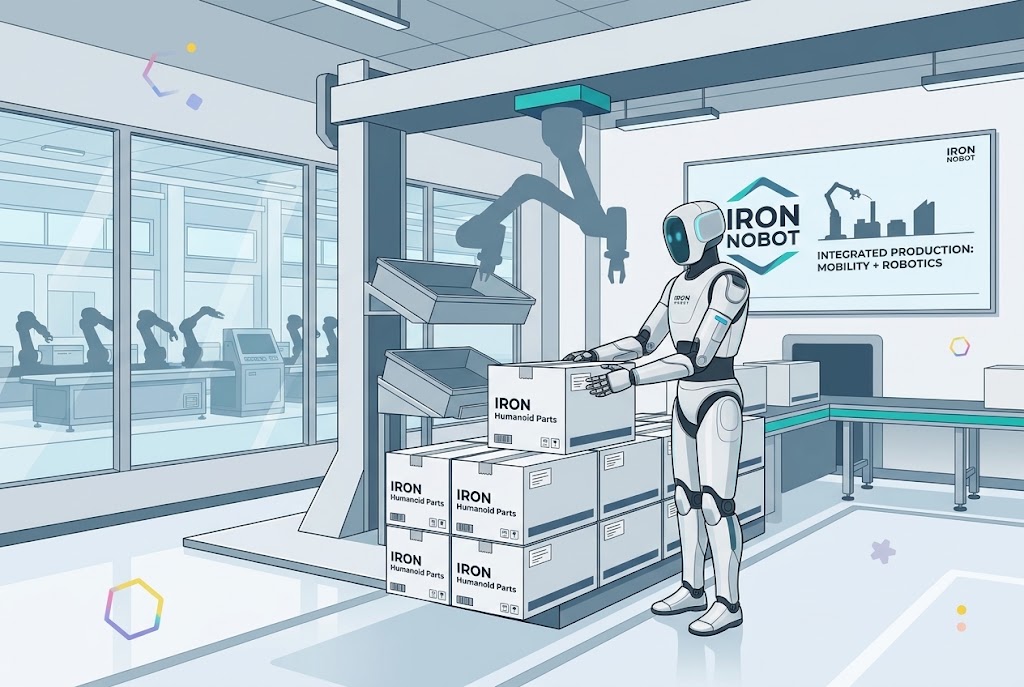
Despite these challenges, the robotics division has set ambitious timelines for its main product. XPeng plans to produce 1,000 IRON humanoids monthly by the end of 2026. The dexterous robot is aimed at retail stores and industrial campuses, and the company said commercial deliveries will begin in 2027. While the humanoid commands most of the headlines, the engineering team has also been working on other mechanical platforms. Dogotix has also developed quadruped and tracked robots for smart home, logistics, power inspection, and security use cases. As an early-stage company, it did report losses in 2024 and 2025.
XPeng is hardly alone in believing that factory floors and retail spaces will soon be populated by machine workers. Other automakers directly involved in humanoid development include Hyundai, which is testing Boston Dynamics’ Atlas, and Tesla, which is preparing to produce its Optimus at scale. BMW Group has deployed Figure AI’s Figure 03 after testing. These manufacturers see a large potential market for mass-produced complex machinery and electronics.
As these platforms mature, the line between an electric vehicle maker and a robotics firm continues to blur. By combining software development with large scale manufacturing, car companies believe they hold a unique advantage in bringing humanoids to market. Whether Dogotix can turn its impressive valuation into market dominance will depend on how quickly its machines can deliver real labor value.


Leave a Reply