
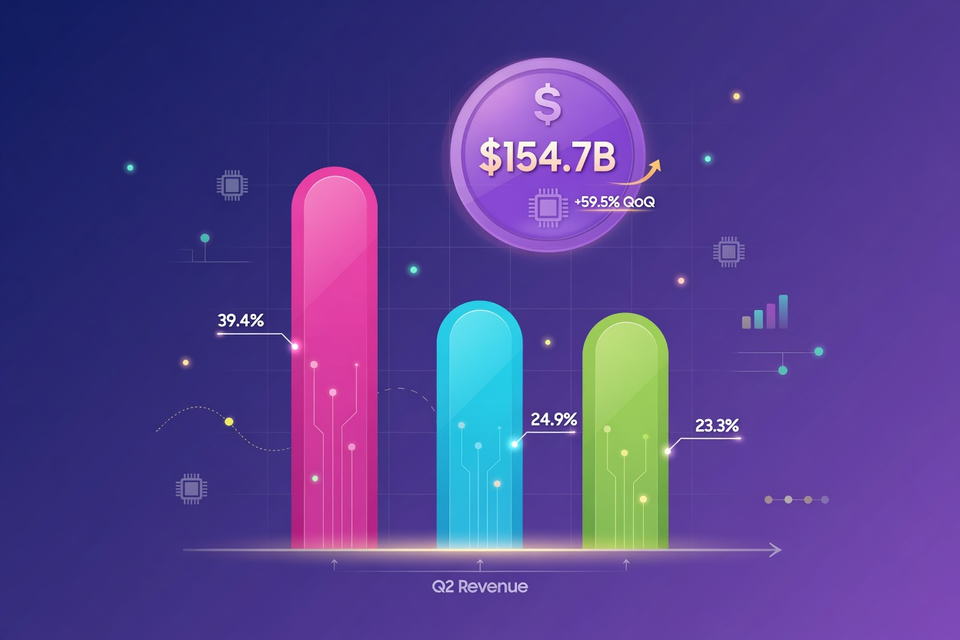
DRAM industry revenue rose 59.5 percent quarter on quarter to nearly US$154.73 billion in the second quarter, according to TrendForce, which ranks Samsung first at 39.4 percent, SK hynix second at 24.9 percent and Micron third at 23.3 percent.
The firm's explanation is price, not bits. TrendForce says its findings "reveal that sharp rises in traditional DRAM contract prices have led to a 59.5% QoQ increase in total DRAM industry revenue, reaching nearly US$154.73 billion in 2Q26." On supply it says "suppliers’ inventories remain at historic lows, with additional supply mainly allocated for server use" and that bit shipments grew only modestly. Decoded: nearly all of the new money is price.
Most of it went to Samsung. TrendForce has its quarterly revenue at US$60.98 billion, up 63.4 percent, with the strongest bit shipment growth of the three, which the firm attributes to its early move into HBM4 mass production and shipments. SK hynix grew 37.9 percent to US$38.59 billion and its share, in the release's phrase, edged down to 24.9 percent. The firm's reason: "Since HBM accounted for the highest proportion of its total bit shipments among the top three suppliers, growth in ASP was relatively limited." Translated, the quarter rewarded whoever shipped the most commodity DRAM, and that was not the HBM leader.
Edged down understates it. Divide each supplier's second-quarter revenue by its own growth rate, my arithmetic from the release's figures, and the first-quarter shares come out at roughly 38.5 percent for Samsung, 28.8 percent for SK hynix and 22.4 percent for Micron. That is close to four points of share gone from second place in three months. Micron, at US$36.0 billion and up 65.5 percent, "continued to prioritize higher-priced server DRAM in its product mix amid capacity constraints." It now trails SK hynix by 1.6 points.
Counterpoint Research counts the same quarter differently. Its quarterly table has Samsung at 38 percent, SK Hynix at 25 percent, Micron at 24 percent, CXMT at 10 percent and Nanya at 2 percent, with the market up 57 percent quarter on quarter. The two firms agree on the order and on the big three holding a little under 88 percent between them; they disagree on every individual share, by up to a point and a half. TrendForce names no Chinese supplier. Its six named vendors sum to about US$139.3 billion, 90 percent of its total, leaving roughly US$15.4 billion unattributed, my arithmetic again.
The forward call is where TrendForce takes a position. "Conventional DRAM contract price growth, however, is projected to moderate to 13–18% QoQ." It cites a shift of some demand from high-capacity RDIMMs to lower capacities and the limited ability of PC and smartphone customers to absorb further increases, while "Consumer DRAM is expected to post the strongest price growth, as suppliers have significantly curtailed supply." Read that as a call on the top of the acceleration, not of prices: a 13 to 18 percent quarterly rise is still a rise.
Supply relief is not coming from new fabs. TrendForce expects the three majors to add bits from 2026 to 2027 mainly by migrating to advanced processes, with wafer starts rising only modestly. Below them, Nanya's revenue rose 68.3 percent to US$2.612 billion on DDR4 and DDR3 contract prices, Winbond's 75.8 percent to US$998 million, and PSMC's DRAM revenue 167.8 percent to US$115 million.
Bootnote: A single point of share in a US$154.73 billion quarter is about US$1.55 billion, more than Winbond booked in DRAM for the whole period. The trackers' disagreements are small in percentage terms and large in dollars, and neither shows its working.



Leave a Reply