
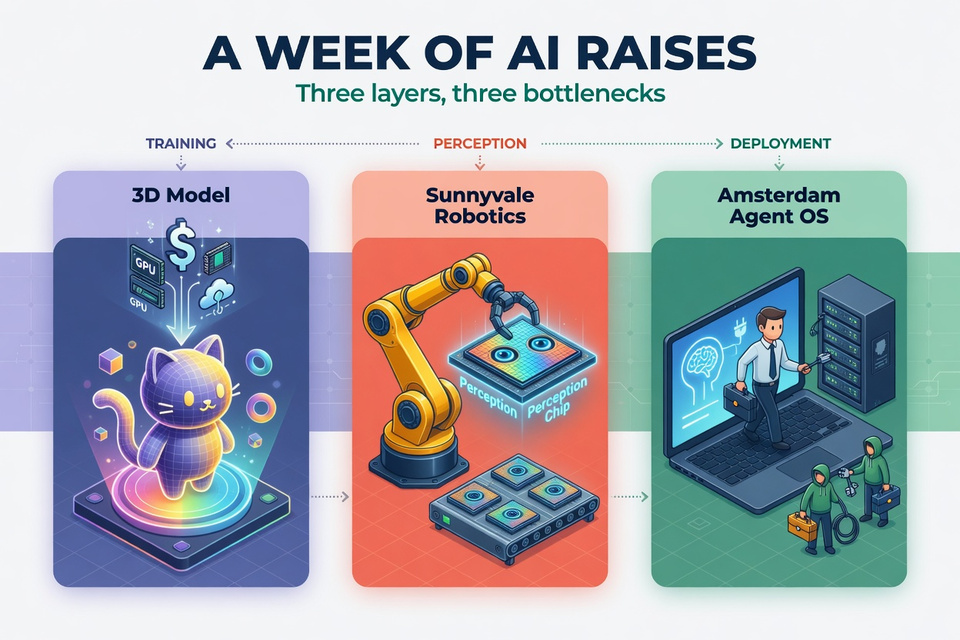
Three companies building at different layers of the AI stack closed funding rounds in the same week, and the money is heading for different bottlenecks. A generative 3D model developer is buying training and inference compute. A Sunnyvale robotics company is scaling production of its own perception chips. An Amsterdam enterprise software company is hiring deployment engineers to get agents into production.
Tripo AI has raised about 3 billion yuan across Series B and Series B+ rounds led by MPCi. Strategic backers include Perfect World, BlueFocus and ThunderSoft, with CICC among the financial investors and existing holders such as Primavera Capital adding to their positions. No valuation and no dollar figure were disclosed.
The round arrived alongside a preview of Tripo P2.0, a 3D-native foundation model that the company says supports quad topology and produces production-ready 3D objects in seconds. Tripo calls the quad support an industry first. No benchmark or third-party evaluation accompanied that claim. Founded in 2023, the company says the capital will go to its foundation models, its 3D data infrastructure and more compute for training and inference.
Further down the stack, Lyte closed a $165 million Series C led by Maverick Silicon at a post-money valuation of $1.6 billion, taking total capital raised since its 2021 founding to $272 million. Fidelity Management & Research Company, which led the Series B, returned alongside Atreides Management, Key1 Capital and Ora Global. Andrew Homan of Maverick Silicon joins the board.
The company designs its own silicon, multimodal sensors and spatial software for robots, and says it has been shipping to inspection, logistics and manufacturing customers since leaving stealth in January 2026. Alexander Shpunt, Lyte's CEO and co-founder, said: "Physical AI has a sensing problem before it has a model problem." Chairman Avigdor Willenz went further on the chip decision: "Owning the silicon separates companies that define a category from those that participate in one." The new money goes to scaling production of that silicon and to hiring across silicon, optics and manufacturing.
By size, the week's biggest cheque went to Wonderful, which closed a $550 million Series C at a $5 billion valuation led by Insight Partners, with Salesforce new to the investor list and Index Ventures, IVP and Bessemer Venture Partners among those returning. Since its Series B in March 2026 the company says it has grown to 650 employees and expanded to more than 35 markets. It sells what it calls an AI operating system, a layer that coordinates agents, workflows and AI-native applications across a business, which it says runs on any cloud or on premises.
CEO Bar Winkler's pitch is about sprawl rather than model quality: "Without a shared operating system, AI risks recreating the sprawl of traditional SaaS." "Wonderful is pursuing one of the largest opportunities in enterprise AI," said Jeff Horing, co-founder and managing director of Insight Partners. The company pairs the software with forward-deployed engineers who bring a customer's first use case into production before handing over.
Each of the three frames its bottleneck as something other than model quality: compute at Tripo, silicon production at Lyte, deployment at Wonderful. That matches our view that the constraint on impact this cycle is infrastructural and organisational. The next set of disclosures from each company would show whether spending on those bottlenecks moved the numbers.




Leave a Reply