
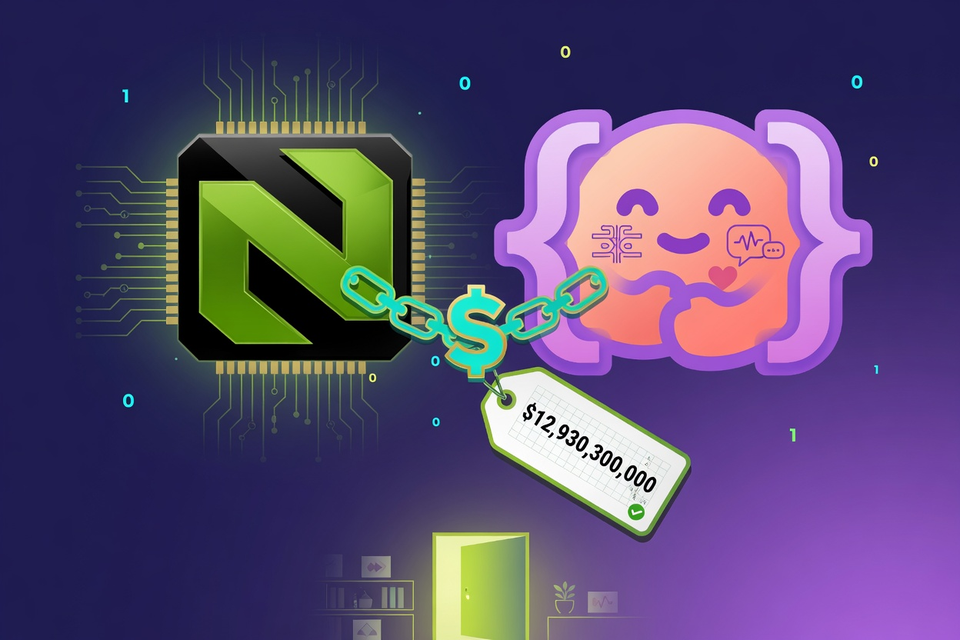
Nvidia has agreed to buy Hugging Face, and Jensen Huang priced the deal the way an engineer would: not roughly $13 billion, but $12,930,300,000, to the dollar. Huang wrote in a blog post announcing the deal: "I’m excited to announce that NVIDIA has agreed to acquire Hugging Face for $12,930,300,000." Here is what all those zeros bought.
Hugging Face is where the AI world keeps its models. Think of it as a public library for machine learning, except the books are trained models, the datasets that trained them and the small apps built on top, and anyone with a login can check one out or shelve their own. Huang's post puts the count at more than 18 million developers, researchers and creators sharing more than 3 million models, 500,000 datasets and 1 million applications, with more than 200,000 companies using the platform. Those are Nvidia's own figures, not an audit.
The word that matters in Huang's post is open. Most of what lives on Hugging Face is open weight, which is not quite the same thing as open source. The weights are the billions of numbers a model learns during training. Publishing them is like handing out the finished cake: anyone can eat it, slice it or add frosting, even if the baker keeps the recipe and the oven to themselves. Huang writes that he recently coauthored an open letter arguing that open weights broaden access to AI.
An obvious worry when a chipmaker buys the model library is that the library starts favoring the chipmaker's chips. Huang addressed that directly: "Hugging Face will remain an open platform for the entire AI ecosystem." He went further on the hardware question: "NVIDIA compute will not be required to build on or deploy through Hugging Face." The post also promises continued support for multi-cloud and multi-accelerator development, which in plain language means models on Hugging Face should keep running on rival chips and rival clouds.
The bet is about position rather than silicon. Nvidia already sells the picks and shovels of the AI boom, and owning Hugging Face puts it at the counter where developers decide which model to run and where to run it. Huang's post describes Nvidia as the largest contributor of open models and data to Hugging Face, with more than 500 models and more than 250 open datasets released there, so this is the library's biggest patron buying the building. The fight in this cycle is over who gets models into production, not whose model scores a few points higher. CNBC reports the acquisition is Nvidia's second biggest on record, behind the $20 billion purchase of assets from chipmaker Groq in December and ahead of the Mellanox deal of almost $7 billion in 2019.
Oddly, the courtship ran backwards. Hugging Face chief executive Clément Delangue told CNBC that his company approached Huang over the summer about a deal, "and a few weeks later, here we are." "During the summer, I think we realized that Hugging Face and open-source AI in general was at the turning point, and that it needed more, more resources, more scale, more visibility," Delangue told CNBC's Becky Quick on Squawk Box.
The interesting question is not whether Nvidia can afford this. It is whether an open platform can stay open inside a company whose business is selling the hardware underneath it. Huang has put the answer in writing, and the platform's download charts over the next few years should show whether the writing held.




Leave a Reply