
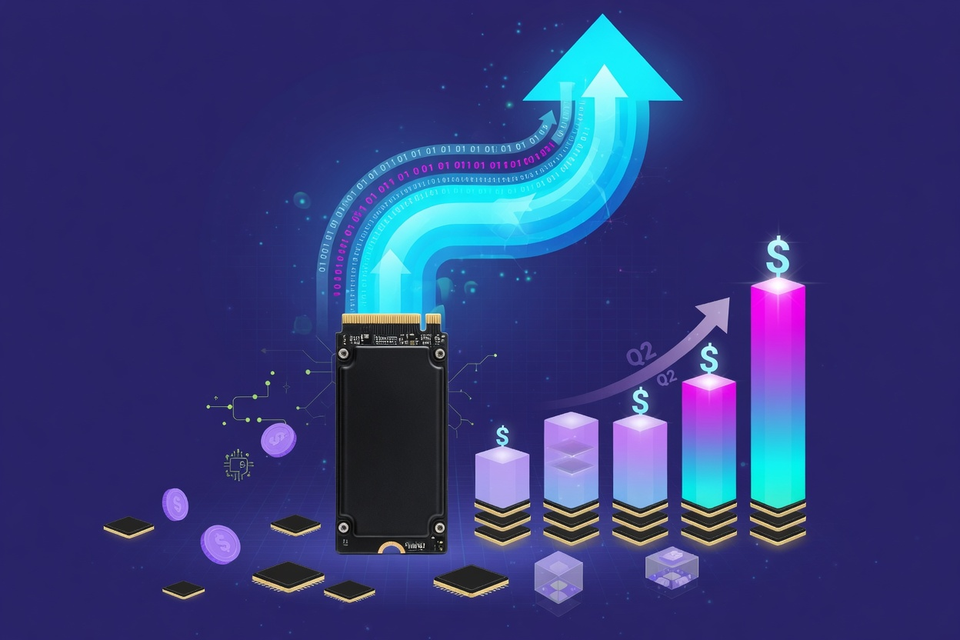
The five biggest sellers of enterprise solid-state drives took in about $37.59 billion between April and June, roughly double what they made in the three months before, according to an estimate published by TrendForce. I read that number three times before I believed it, and I write about this stuff for a living.
An enterprise SSD, for anyone who has only ever bought the consumer kind, is the flash storage that goes into servers rather than laptops. Think of it as the pantry next to the kitchen where AI models do their cooking. Graphics processors get the headlines, but every model needs somewhere to fetch its ingredients from, and that pantry is being restocked at a furious pace.
TrendForce puts the quarter-on-quarter jump at 103.6 percent and credits two things: more drives shipped, and higher contract prices for each one. Its previous report had the same five companies at $18.46 billion for the first quarter, so the doubling is TrendForce's own arithmetic laid end to end, and it lines up.
Top of the table is Samsung, with roughly $14.35 billion, which by my calculator is about 38 percent of the group's combined revenue. TrendForce says the company ramped shipments of drives built on 176-layer QLC flash and sold a bigger share of high-end PCIe 5.0 products. QLC, pronounced letter by letter, stands for quad-level cell, meaning each memory cell stores four bits instead of the usual three. You trade some speed and endurance for a lot more capacity per dollar, which is exactly what a data center hoarding training data wants.
In the release, TrendForce says: "As major North American CSPs accelerate the transition of their data center architectures from PCIe 4.0 to PCIe 5.0, Samsung’s ability to provide both DRAM and NAND Flash has made it a preferred supplier of memory and enterprise SSDs for many server customers." CSPs are cloud service providers, the Amazons and Microsofts of the world, and PCIe 5.0 is simply the faster generation of the slot the drive plugs into.
The SK hynix group, which includes its subsidiary Solidigm, ranked second at just over $8.63 billion, with SK hynix pushing 321-layer TLC drives while Solidigm leaned on QLC for ultra-high-capacity models. Micron grew fastest of the five, up 126.3 percent to about $6.98 billion, which lifts it into third. TrendForce notes that Micron has been steering more of its factory output toward enterprise SSDs and HBM since the AI boom began and is among the leaders qualifying PCIe 6.0 drives.
Fourth place went to Kioxia, which more than doubled to $4.64 billion as its 218-layer flash cleared qualification at big North American cloud customers. SanDisk rounded out the table at nearly $2.98 billion, up 102.9 percent, as its high-capacity QLC drives moved into volume production.
The bet the whole industry is making is that this is not a one-quarter sugar rush. TrendForce writes: "TrendForce expects enterprise SSD demand to remain elevated in 3Q26 thanks to the growing adoption of generative AI agent services, steady data center infrastructure deployments by CSPs, and large-scale shipments of NVIDIA GB-series AI server racks." It also flags rising output from Chinese suppliers and a home-grown Chinese cloud market as the things that could rearrange the table.
One caveat worth carrying with you: these are an analyst firm's estimates of vendor revenue rather than audited figures from the companies themselves, and TrendForce describes the quarter in the language of expectation rather than of reported results. The direction is hard to argue with. The decimal points deserve a pinch of salt.



Leave a Reply