
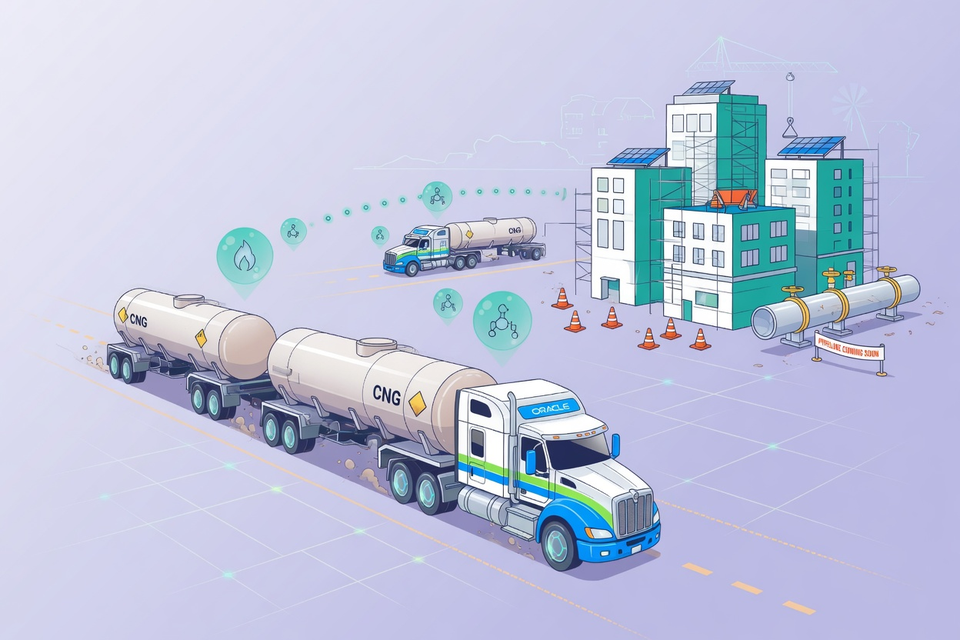
Oracle is keeping several AI data centers on schedule by trucking natural gas to the site instead of waiting for a pipeline, Bloomberg reports, citing people familiar with the work. Truck deliveries kept a data center on the outskirts of Salt Lake City moving forward for more than a year while Oracle waited for a gas pipeline to be built and connected to its equipment, and the same approach is being used to get initial work done at a campus being built for OpenAI in Shackelford County, Texas.
Beyond its paywall, as relayed by Investing.com via Yahoo Finance, Oracle is now considering the same method for Project Jupiter in New Mexico, where a delayed pipeline threatens the schedule, so that early stages of the facility can come online before the pipe is in service. Certarus, a unit of Superior Plus, supplied the Utah deliveries and VoltaGrid the Texas ones. Oracle has posted publicly thanking VoltaGrid for keeping Oracle Cloud Infrastructure capacity on schedule, per the same account.
The product being bought here is what the industry calls a virtual pipeline. Gas is drawn from a real pipeline, compressed into trailers, driven to the site and decompressed into the generation plant, as The Next Web describes it from the Bloomberg piece.
That price is the number a buyer should carry into the meeting. Delivered by road, gas runs about four times the price at a major trading hub once labor, equipment and the trucks' own fuel are counted, East Daley Analytics told Bloomberg, as relayed by The Next Web. Bloomberg's text gives no figure for Oracle's spend on the service, and neither Certarus nor VoltaGrid has published pricing for these contracts. The trade-off: an operator pays a multiple on fuel for months or years in exchange for commissioning on the original date rather than the pipeline's.
New Mexico shows why an operator would accept that. In April, Oracle and BorderPlex Digital Assets said Project Jupiter would be powered entirely by up to 2.45 gigawatts of Bloom Energy fuel cells, replacing the gas turbines and diesel generators in the earlier plan, according to Oracle's announcement. Fuel cells still need gas. Energy Transfer had to reroute the pipeline meant to serve the campus after the New Mexico State Land Office refused rights-of-way twice, pushing its service date to February, The Next Web reports from the Bloomberg account. Last month Oracle sent the project's developer a force majeure notice, which may shield it from certain payments if the delay runs further.
For a facilities engineer, the practical questions are throughput and permits. A compressed gas trailer carries a fixed volume, so a campus drawing hundreds of megawatts needs a steady stream of them, and the road and air permits for the trucks and the on-site generation are the operator's to secure. Neither Bloomberg nor its carriers say how many trailers a day the Utah site took or whether the New Mexico air permit covers trucked supply.
Competition for the work is narrow. Certarus and VoltaGrid are the two named suppliers, and VoltaGrid also sells mobile generation to pair with its gas. Grid interconnection remains cheaper wherever a utility can deliver it, and a pipeline beats trucks on cost the day it is energized; trucked gas is a bridge priced accordingly.
A gigawatt-scale AI campus can evidently be started on trucked fuel if the operator will pay a multiple for the privilege. Buyers facing a pipeline or interconnection slip now have a precedent, and a price, to set against the cost of a late opening.



Leave a Reply