
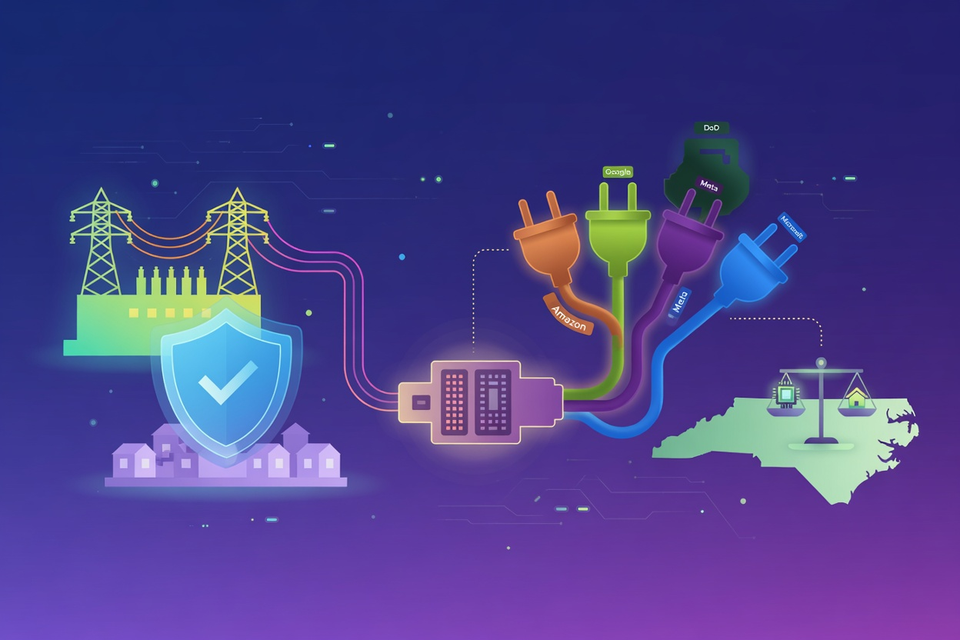
Duke Energy has reached a settlement with North Carolina's Public Staff, the state agency that represents utility customers, on the terms under which data centers and other large loads connect to its grid. Amazon, Google, Meta, Microsoft, the Carolina Industrial Group for Fair Utility Rates and the U.S. Department of Defense are also parties, according to Duke's announcement. The agreement goes to the North Carolina Utilities Commission, and Duke expects a decision by mid-November.
The settlement covers Duke Energy Carolinas and Duke Energy Progress, which together serve about 3.9 million customers in the state and are due to merge into a single utility on January 1, 2027. If approved, it applies to any customer of 50 megawatts or more running at an 80 percent load factor that signs an electric service agreement after June 1, 2026. Duke says earlier agreements already carry similar protections, and that its previous contract terms applied from 100 megawatts.
Three terms do the work. A new large customer pays upfront and nonrefundably for grid facilities that serve only that customer, such as a dedicated substation. It also posts deposits and security guarantees for upgrades that serve all customers, such as transmission lines. And it takes service under a High Load Factor rate schedule, a separate tariff for large loads rather than the general industrial rate.
"It’s simple – data centers will pay upfront for all costs to connect to the grid," said Kendal Bowman, Duke Energy's North Carolina president, in the announcement. "We’re shielding other customers from these costs in a way that protects reliability and ensures everyone benefits from the economic growth coming to North Carolina." What the release does not state is how the shared-upgrade deposits are sized, or how much of a transmission project a single customer will be assigned.
Axios reports that the proposed settlement was submitted to the commission on Tuesday and fills in some of that detail. The rules apply to customers above 50 megawatts that run consistently near peak, or to any customer above 150 megawatts, thresholds Axios notes will catch the largest data centers and few conventional industrial plants. Axios also reports a minimum monthly payment of at least 75 percent of projected demand regardless of actual use, damages if a customer terminates its contract or cuts its contracted demand, and a request for the commission to approve a methodology for assigning network upgrade costs to individual projects.
Missing from the agreement is any clean energy obligation. Axios reports that no clean energy group signed the settlement, and that Matt Abele of the North Carolina Sustainable Energy Association called it short of what the state needs on electricity costs, arguing that large users should supply more of their own demand from clean resources. Governor Josh Stein said in a statement reported by Axios that his office is reviewing the settlement.
The settlement builds on Duke's earlier moves. Duke says it put large-load protections in place in 2024 and announced its Customer Protection Plus framework in July, and that this agreement extends that framework to address points raised by regulators and customers. A commission-approved tariff is a filed rate with enforceable terms, where a framework is a utility's own policy.
For an operator planning 50 megawatts or more in Duke's North Carolina territory, the cost of a dedicated substation now lands upfront and stays with the customer whether or not the project reaches full load. The deposit methodology and the 75 percent minimum bill are the terms to model before signing, because they set the carrying cost of a campus that ramps slower than planned.



Leave a Reply