
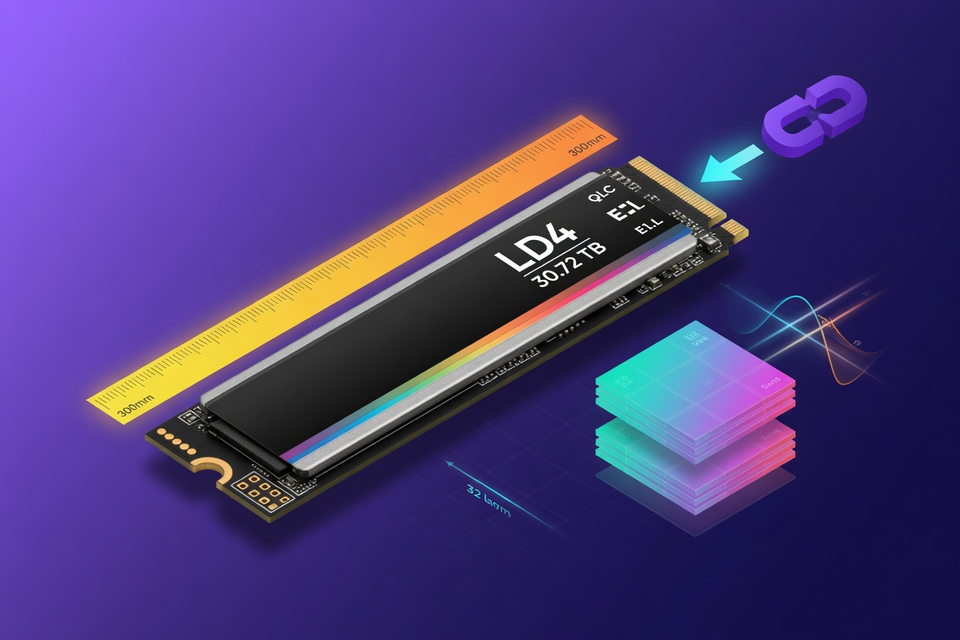
Kioxia is sampling its first E1.L drive, the LD4 Series, a single-port QLC SSD at 15.36 TB and 30.72 TB built on BiCS FLASH generation 8 and aimed at read-intensive storage in high-density 1U hyperscale servers, according to the company's release.
"The continued growth of data-intensive workloads is driving demand for higher-capacity storage in hyperscale data centers," said Neville Ichhaporia, senior vice president and general manager of the SSD business unit at Kioxia America. Decoded, that is about who is buying and how. The hyperscaler buys capacity by the rack unit, and the long ruler is the form factor that puts the most NAND packages behind a single front-panel slot in a 1U chassis.
ServeTheHome puts the geometry plainly: E1.L is 9.5 mm thick and 318.75 mm long, a shape that extends the printed circuit board deep into the chassis to make room for more flash sites, and two 30.72 TB drives of it take up very little front-panel area. That matters, STH notes, for front-cabled servers and for ORv3 racks that carry power, liquid cooling and interconnect at the rear, where 1U-compatible capacity makes sense even as the industry's attention for pure density drifts toward E3.L and E2.
Now the interface, which the release describes in a way worth reading twice. The feature list gives PCIe 5.0 with Gen 4 x4 in parentheses, and the footnote attached to it says the drive is compliant with the PCIe 5.0 specification with speed up to 16 gigatransfers per second per lane across four lanes. Sixteen GT/s is Gen 4 signaling; Gen 5 runs at 32. Four lanes at 16 GT/s is a ceiling of roughly 8 GB/s, by my arithmetic. STH describes the LD4 as a PCIe Gen5 NVMe SSD, which is true of the specification it claims and not of the link rate the footnote gives. For a capacity drive built to be read, that is a defensible choice. QLC dies are not the bottleneck a 32 GT/s link would relieve, and a slower link costs less power per slot across the dozens of slots a 1U ruler server exposes.
What the release does not say is as informative as what it does. There is no sequential or random performance figure, no endurance rating in drive writes per day, no power number and no price. The only quantities offered are the two capacity points, the 122.88 TB that the "validated architecture" can reach, NVMe 2.0e, and compliance with OCP Datacenter NVMe SSD Specification 2.6, which is the document a hyperscaler's qualification team actually tests against. Read the 122.88 TB figure for what it is: a statement that the controller and firmware have been validated for that capacity, not that a drive of that size exists to order.
The availability language blurs two things that matter to a buyer. The release says 15.36 TB and 30.72 TB are available "today" and, two paragraphs later, that LD4 drives are "currently sampling to select customers" ahead of a showing next week. Sampling is the right reading; nothing in the release gives a volume date.
At the OCP Global Summit in San Jose on October 12 to 15, the LD4 will sit alongside a GP Series demonstration on XL-FLASH generation 3 that the company says will show more than 20 million 512-byte random read IOPS, according to its companion release. One drive is built to be hammered; the other is built to be filled. Until Kioxia publishes an endurance figure for the one built to be filled, the phrase "read-intensive" is doing the work a DWPD number should.




Leave a Reply