
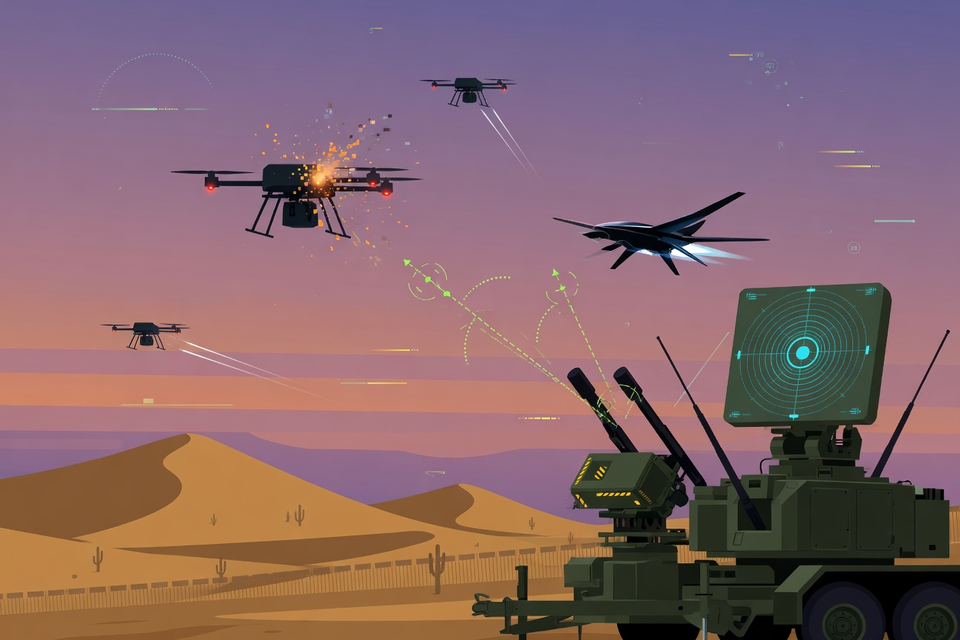
The United States Army spent part of September in the Arizona desert watching contractors try to knock small drones out of the sky, and the first name on the list was Anduril, whose Ghost drone flew in the demonstrations. Reuters reports, in a dispatch from Yuma that I read through Yahoo News's republication of the wire text, that the Army is testing counter-drone technology along the US-Mexico border for two reasons: cartels are flying more drones across it, and the Army wants to copy the speed at which Ukraine's forces adapt their equipment.
Start with the number. Brigadier General Brian Filler, deputy commander for operations at Joint Task Force Southern Border, told reporters the military had detected 378 drone incursions in the previous 30 days, and that the trend was rising. Divide that out and it is a little over twelve a day, which is the kind of arithmetic that turns a curiosity into a procurement line.
These are not exotic machines. Filler said the military is seeing largely commercial off-the-shelf drones, which the Army shortens to COTS and pronounces like the folding beds, and most carry surveillance cameras. Army officials say they are flown by criminals for surveillance tied to smuggling and human trafficking. Think of it less as a stealth bomber problem and more as a camera drone anyone can buy at a mall, multiplied by a few hundred.
The showcase was Falcon Peak, an exercise run by US Northern Command in September in Arizona. Defense firms demonstrated radars, interceptor drones, autonomous gun systems and other technology built to detect, track and destroy small unmanned aircraft. Those three verbs are the business: a radar or a camera spots the intruder, software keeps a lock on it, and then something has to physically stop it, which is where most of the money sits.
Several companies had that last job covered. Reuters names Teledyne FLIR's radar-and-camera detection system, an automated machine gun called the Bullfrog from Allen Control Systems, and an interceptor drone sold by Powerus, which Reuters says has just gone public by merging with a company backed by sons of President Donald Trump. There are also lasers in the mix: the military has said it downed 11 cartel drones with lasers since deploying that technology along the border in August.
Here is the part I find more interesting than the hardware. Military officials caution that cartel drones are not comparable to the sophisticated battlefield drones seen in Ukraine or the Middle East, but the border offers a place to test equipment, train soldiers and evaluate how systems perform outside controlled laboratory conditions. Brigadier General Matt Ross told reporters that the military looks at Ukraine and is impressed by how quickly it can adapt on a daily or weekly basis, and that what it should really do is replicate that process.
That framing matters for the companies in the room. Since Russia's 2022 invasion of Ukraine, investors have poured billions of dollars into Anduril, Shield AI, Saronic and a wave of smaller drone and counter-drone startups seeking military contracts, and a live border is where those bets get graded. What Reuters does not report is any contract value, any purchase decision, or which of the demonstrated systems the Army intends to buy, so treat Falcon Peak as an audition rather than a sale.
I will admit I once assumed counter-drone work meant a very large net. It turns out to mean radars, software, bullets, lasers and an argument about iteration speed, and the Army has picked a stretch of desert where the test targets keep showing up on their own.




Leave a Reply