
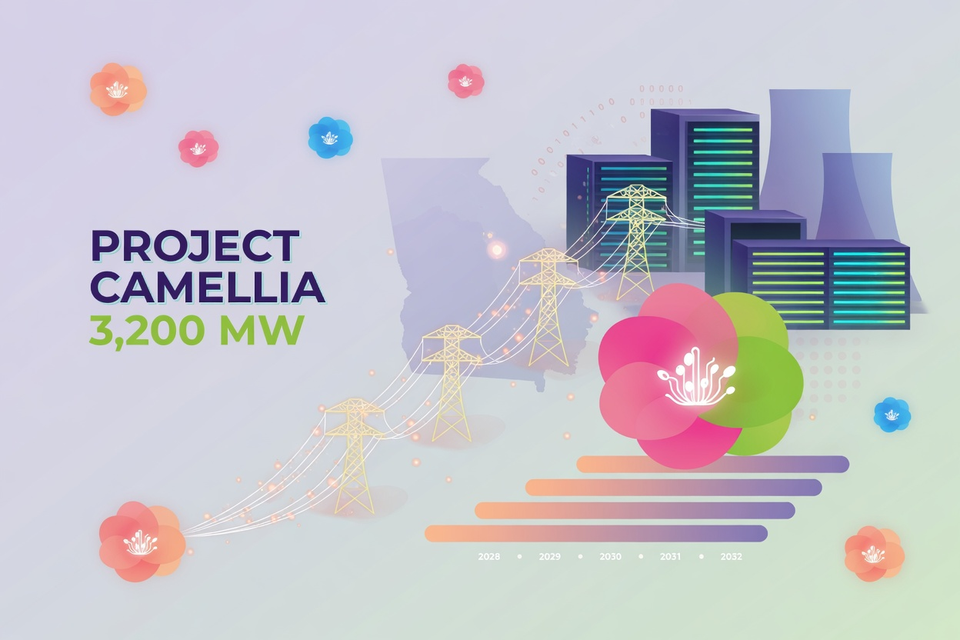
Georgia Power's contract to serve OpenAI's planned Effingham County data center has cleared state regulatory review, CBS News Atlanta reports, with Public Service Commission staff declining to object and no public vote taken. The agreement calls for up to 3,200 megawatts delivered in phases from 2028 through 2032 to the project OpenAI calls Project Camellia and values at $20 billion.
The clearance follows the mechanics this desk outlined two days ago: under Georgia's large data center rules, staff review the contract in a 30 day window, and absent objection the deal proceeds. Staff negotiated rather than objected, and the terms that emerged are the operative substance for anyone tracking how large load contracts are shaping up.
Cost allocation is the headline term. Georgia Power says OpenAI will pay the full cost of infrastructure needed to serve the facility, per the report, which is the guarantee commissioners flagged as needing enforcement muscle behind it. The second term matters as much for grid planners: OpenAI has agreed to let the utility curtail the facility by up to 1,000 megawatts when grid demand runs high, meaning nearly a third of the campus's load is interruptible on the utility's call.
Rate projections came upgraded alongside the clearance. Georgia Power now projects revenue from OpenAI and other large customers could save a typical residential customer using 1,000 kilowatt hours about $15 a month beginning in 2029, roughly $180 a year against its December estimate of $102, per the report, with chief executive Kim Greene framing the increase as a commitment kept. The utility attributes the projected savings to about $950 million in expected additional annual revenue from its growing roster of data centers and large users, not to OpenAI alone.
OpenAI's side of the ledger includes commitments worth watching for follow-through: thousands of construction and permanent jobs, $80 million in community benefits, hundreds of millions in state and local taxes, a closed loop water system, and an annual independent audit of its commitments, per the report.
What did not change from earlier in the week is the transparency posture. The contract's terms remain trade secrets with the public copy fully redacted, so the savings projections and cost guarantees arrive as utility statements rather than inspectable terms, and enforcement still depends on commissioners who never voted on the deal.
Buyers and operators should file the two hard numbers: full infrastructure cost on the customer, and 1,000 megawatts of curtailment rights on the utility. Those are the terms Georgia's process produced under a savings-focused political spotlight, and they are now the benchmark any large load negotiation in the Southeast will be measured against.




Leave a Reply