
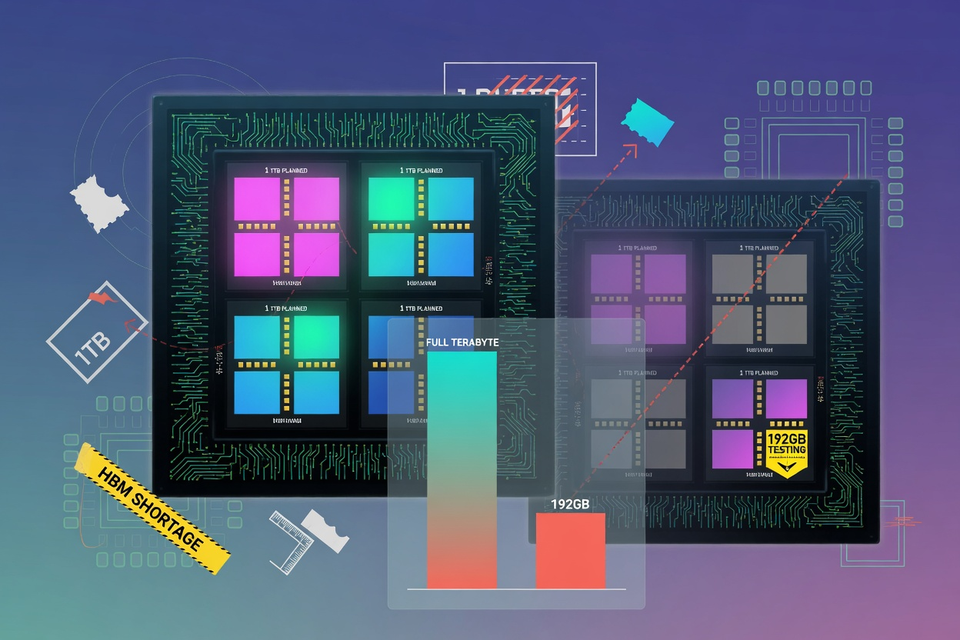
Nvidia designed Rubin Ultra, the top-shelf accelerator on its roadmap, around a full terabyte of high-bandwidth memory. Now Nvidia is testing versions of the chip that carry as little as 192 gigabytes, according to reporting from The Information relayed by Seoul Economic Daily and 24/7 Wall St. That is roughly a fifth of the plan, and I say this as someone who once had a kitchen renovation descoped in real time: the way a project sheds ambition tells you exactly where the pain is.
HBM, pronounced letter by letter, is memory stacked straight up beside the processor so data makes a short commute instead of a crosstown trip. The original Rubin Ultra recipe called for HBM4e, the newest generation, arranged in 16 stacks totaling one terabyte per GPU. Seoul Economic Daily reports that test samples now carry 192 or 256 gigabytes, and that some of them step back to plain HBM4, the generation already shipping.
Here is the detail that made me put my coffee down. Nvidia's current Rubin GPU, the very chip Rubin Ultra is supposed to tower over, already supports up to 288 gigabytes of HBM4 and 22 terabytes per second of memory bandwidth. Depending on which test configuration wins, the Ultra could arrive wearing less memory than the chip below it on the price list.
The cause is not mysterious. 24/7 Wall St. points to HBM4e supply constraints and qualification delays, which is the industry's polite phrasing for cannot make enough of it yet, and the samples are not passing tests fast enough. Nvidia has been working the supply side hard, including a 500 billion dollar infrastructure partnership with SK Group that Seoul Economic Daily notes was struck partly to secure HBM.
For Micron and its fellow memory makers, the arithmetic is direct: every accelerator that ships with fewer gigabytes means fewer memory bits sold. Before anyone writes an obituary for the HBM boom, though, BofA Global Research finds that accelerator performance falls off sharply below 500 gigabytes, and the coming generations of stacked memory target 500 gigabytes to a full terabyte per chip. 24/7 Wall St. reads the cuts as a supply bottleneck rather than a change in appetite, a distinction that matters greatly if the shortage eases.
"Vera Rubin is designed for agentic AI and massive long-context workloads," Nvidia says of the platform, and that kind of work eats memory the way my nephew eats dumplings. Mass production of Rubin Ultra is scheduled after the end of 2026, which leaves time for HBM4e to qualify and for the roomier configurations to win out. The number I am watching is not the launch date. It is how many gigabytes ride on each card when the trucks finally roll.




Leave a Reply