
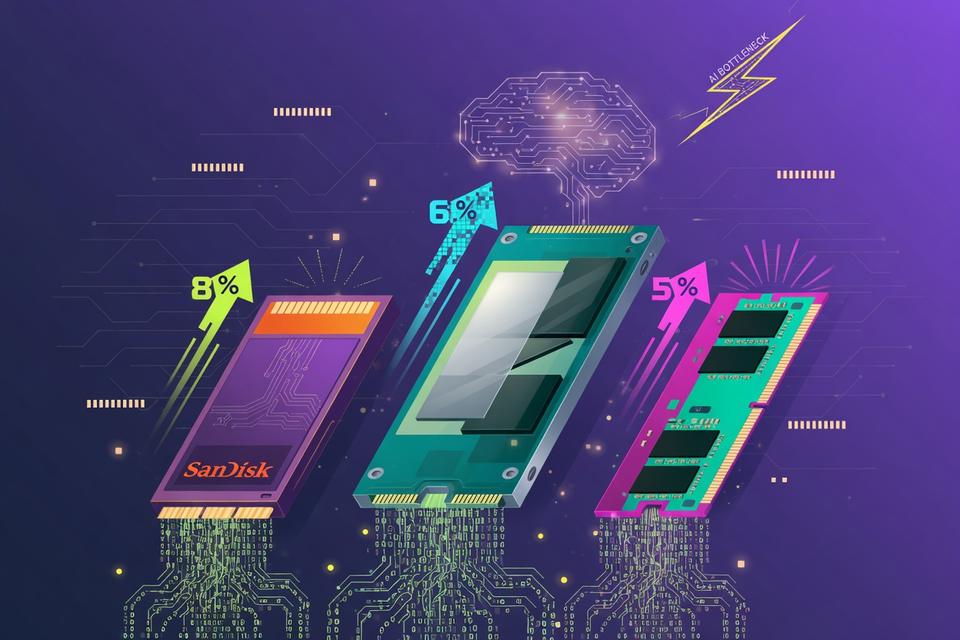
The memory business is having its main-character moment. SanDisk rallied 8 percent to $1,778, Western Digital climbed 6 percent to $540, and Micron added 5 percent to $1,017 after Elon Musk pointed at memory, of all things, as the part actually holding back artificial intelligence. As someone who once soldered DRAM modules to pay for noodles in grad school, I feel seen.
It started small and very Musk. Peter Diamandis posted on X that "Memory, not compute, is the rate limiter of the Agentic Era," and Musk replied, "Few realize this." He had already told listeners on SpaceX's second-quarter call that "the limiting factor in building out AI computing capacity now is the supply of memory." Three words of agreement from him were enough to move the largest names in storage at once.
Here is why the crowd is right to care. A modern AI accelerator is the world's fastest eater with the world's smallest plate. DRAM, pronounced dee-ram, is that small fast plate sitting right next to the processor; NAND, the flash memory inside SSDs, is the pantry down the hall. Training and running models means refilling the plate billions of times a second, and if the plate does not get bigger, a faster eater just waits more elegantly.
The supply math explains the stampede. The Motley Fool reports that memory production capacity is growing at roughly 20 percent a year while demand has risen about 200 percent, and prices have moved the way you would expect. SanDisk's fiscal fourth quarter, which ended July 3, grew 51 percent from the prior quarter, with about two thirds of that gain coming from higher prices rather than from more chips out the door.
Memory executives have been saying versions of this for a while, with less reach than Musk. Micron chief executive Sanjay Mehrotra told analysts that "DRAM and NAND industry demand continues to significantly exceed industry supply," and the company expects tight conditions to persist beyond calendar 2027, according to 24/7 Wall St. Micron's chief business officer, Sumit Sadana, says customers now name DRAM as their primary constraint, ahead of power and data center capacity. Sit with that ordering for a second: the chips are scarcer than the electricity.
The rally ran across the whole complex. Seagate added 2 percent to $992, SK Hynix rose 4 percent to $173, and the Roundhill Memory ETF, which trades under the wonderfully on-the-nose ticker DRAM, gained 5 percent to $60.20, per 24/7 Wall St., which also notes the group remains 15 to 30 percent below its June highs. SanDisk chief executive David Goeckeler argues the "real value creation is going to happen" ahead and says the company is working to "dampen" the industry's famous boom-and-bust rhythm.
That rhythm is the bet underneath all of this. Memory makers have historically answered high prices by building factories until prices collapsed, and whether this generation of executives can resist reaching for the shovel is the open question. If demand keeps outrunning supply at anything like ten to one, the bottleneck Musk flagged could stay the industry's favorite problem for years.



Leave a Reply