
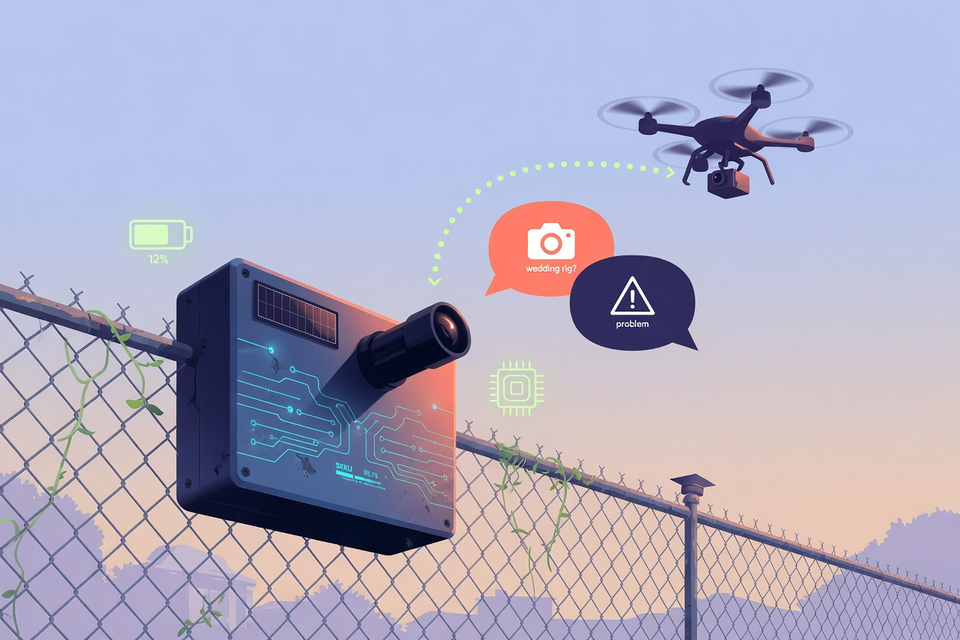
Somewhere on a fence line right now, a battery-powered box is squinting at a buzzing dot and trying to decide whether it is a wedding photographer's camera rig or a problem. Researchers at Sungkyunkwan University in South Korea say they can make that call on 88.7 percent less power, and the engineer who led the work has not yet collected his bachelor's degree.
The system is called UAV-NAS, and it identifies a drone's type and flight status from the radio signals the aircraft cannot help but emit. Every drone chatters with its controller, and that chatter has an accent. Read the raw radio waveform, the I and Q components engineers use to describe it, and a trained model can tell one airframe from another without ever seeing it.
The clever part is who designed the AI that does the reading. Nobody did. UAV-NAS uses a technique called neural architecture search, which means the computer explores possible model designs on its own and keeps the one that performs best on a tight power budget. The university's announcement describes the goal as finding the "leanest and most efficient AI architecture" for the job, which is a fair summary of the entire field's current obsession.
That lean model then moves onto an FPGA, a field-programmable gate array, pronounced letter by letter. Think of an FPGA as a chip made of rewireable circuitry, closer to a whiteboard than a printed poster: you sketch exactly the circuit your model needs and nothing else. A general-purpose CPU carries the overhead of being ready for anything, and the 88.7 percent saving is measured against exactly that baseline.
Power is the entire point here. Earlier AI detectors worked, but as the announcement puts it, the approach "required an immense amount of computer calculations and consumed a vast amount of electricity." A monitoring station that drains its battery by lunchtime is a paperweight by dinner. The team pitches UAV-NAS at round-the-clock monitoring of unauthorized drones in military and industrial settings, where the watching never stops and the wall socket may be far away.
The work appears in IEEE Transactions on Industrial Informatics, in the journal's August issue. One number the public materials do not give is identification accuracy; the university says the system identified drone types and flight status with high accuracy and leaves it there, so treat that part as promising rather than measured.
As for lead author Doyeon Kim, he wrote the paper as an undergraduate in Sungkyunkwan's electronic and electrical engineering department under professor Wansu Lim, graduates in August, and starts a fully funded PhD at Purdue University in September. I went back and reviewed my own undergraduate lab notebooks before writing this, and I can report that the gap between his final project and mine is not 88.7 percent. It is larger.




Leave a Reply