
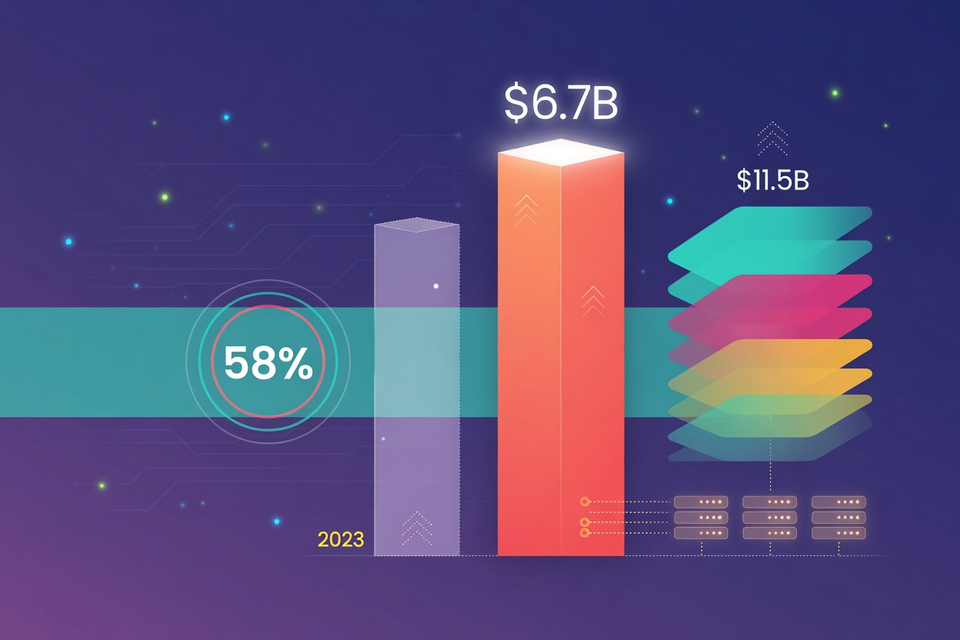
AMD closed out a quarter in which its data center division brought in $6.7 billion, more than double the figure from a year ago, and 58 percent of everything the company earned. Total revenue reached a record $11.5 billion, up 50 percent. I have covered this company since the era when its server business fit comfortably inside a rounding error, so allow me a moment of quiet astonishment.
The profit line moved even harder than the revenue line. Data center operations earned $2.1 billion in the quarter against a loss of $155 million in the same period a year earlier, a swing the company's quarterly filing credits to demand for EPYC processors and Instinct MI350 GPUs. EPYC is the server chip family, pronounced exactly like epic, and yes, that is deliberate. Instinct is the accelerator line that does the arithmetic behind AI models.
"We delivered an excellent quarter, with record revenue and profitability as Data Center revenue more than doubled year-over-year," chief executive Lisa Su said in the results announcement. Gross margin reached 56 percent on the adjusted basis companies prefer to talk about, with adjusted earnings of $1.66 per share.
Quietly, the rest of the company did its job without headlines. Client and gaming contributed $3.8 billion, up 6 percent, and the embedded business added $977 million, up 19 percent.
Helios is the product to watch in the second half. AMD describes it as the world's most powerful AI server rack, and the pitch is simple to picture. Rather than shipping accelerators in boxes and letting each cloud wire thousands of them together, AMD delivers the whole rack as one engineered machine, closer to buying a finished bookshelf than a bag of planks and screws. The company says Helios is already deployed by Meta, Microsoft, OpenAI, Oracle and Anthropic, along with the specialist clouds Cirrascale, HUMAIN, Tensorwave and Vultr.
"We enter the second half with strong momentum as EPYC demand accelerates, Instinct deployments scale and Helios begins to ramp," Su said. Guidance for the current quarter calls for roughly $13 billion in revenue, give or take $300 million, which would be growth of about 41 percent from a year earlier.
Finance chief Jean Hu framed the trajectory the same way. "We expect Data Center sales to accelerate in the second half of 2026, driving stronger overall revenue growth and continued earnings expansion," she said. Investing.com reports the shares slipped in after-hours trading all the same.
The bet underneath the numbers is rack-scale. The new MI400 series splits into the MI455X for large-scale AI training and inference and the MI430X for high performance computing, the supercomputer end of the pool, and both are built to live inside Helios. If deployments scale the way Su describes, the second half becomes a test of whether AMD can build racks fast enough, not whether anyone wants them.


Leave a Reply