
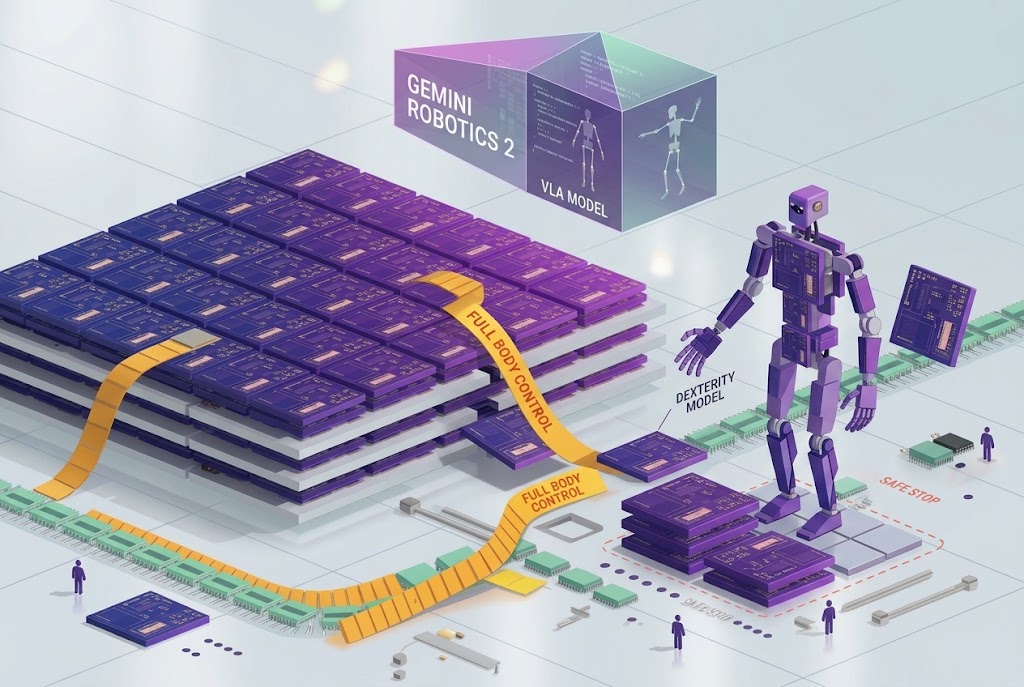
The boundaries of physical artificial intelligence continue to expand rapidly as research labs tackle complex human motion. Google DeepMind last week unveiled Gemini Robotics 2, the latest version of its vision-language-action, or VLA, model. While early models focused primarily on basic upper body tasks, this upgraded system marks a major shift toward whole body coordination and collaborative problem solving.
With the first version, the company showed how Gemini’s multimodal understanding could drive real-world action. The updated version includes intelligent whole-body control, advanced dexterity, and multi-robot collaboration, DeepMind said. This allows machinery to reason through complex physical sequences rather then executing simple rigid routines.
The new system expands the physical capabilities of humanoid frames significantly. For example, when controlling Apptronik‘s Apollo 2 humanoid robot, users can ask it to “put the watering can into the green bin in the bottom shelf.” Apollo processes the instruction, walks to the table, and picks up the watering can, takes a few steps to the shelves, and places it precisely in its destination.
Beyond general movement, fine motor control remains a massive priority for researchers. To be genuinely useful in our homes and workplaces, DeepMind said robots need finesse. Gemini Robotics 2 unlocks a new level of physical dexterity across different end effectors, whether a robot is using hands or grippers. The model can now control the five-fingered, 22 degree-of-freedom SharpaWave hand on the Apollo 2 robot to complete delicate actions like tying knots or sealing a ziplock bag.
To handle long projects, the tech giant introduced dedicated reasoning architecture. Gemini Robotics ER 2 serves as the robot’s high-level brain, processing user instructions and communicating with humans. It observes the room, reasons about the steps needed to complete the task, coordinates with the VLA to carry out the actions, and tracks progress until the task is done. This high level reasoning allows machines to adjust when unexpected problems happen.
The software suite also includes Gemini Robotics On-Device 2, which is optimized to run locally on hardware without network latency. The model can now achieve fast adaptation to completely new robot embodiments with a few hours of data, DeepMind said. This flexibility lets hardware makers deploy the system across drastically different machine shapes quickly.
Throughout these updates, safety protocols remain a top concern for developers working alongside human partners. Google DeepMind said safety is foundational to its robotics research. The new model can better detect when humans are nearby, trigger safety tool calls, and bring the robot to a safe stop if someone approaches too closely. These features ensure that as machines gain strength and autonomy, they remain safe assistants in shared spaces.


Leave a Reply