
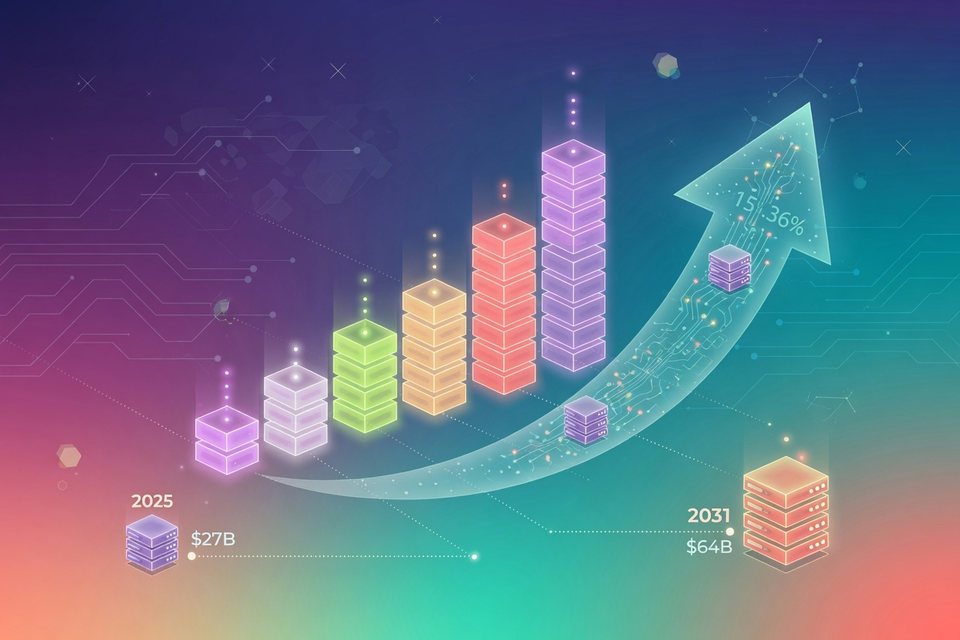
ResearchAndMarkets.com projects the Asia-Pacific data center colocation market will grow from $27.19 billion in 2025 to $64.08 billion by 2031, a 15.36 percent compound annual growth rate that would more than double the size of the region's rentable capacity market in six years.
Colocation, the business of leasing space, power and cooling inside a shared facility rather than building one, is where most enterprises and a growing share of AI tenants actually contract capacity in the region. The report attributes the growth to digital transformation across cloud computing, e-commerce and fintech, alongside government investment in AI development across APAC nations.
China leads the region by investment value, according to the report, followed by Japan and Australia. India, South Korea and New Zealand show significant development activity behind them. Southeast Asia is described as restructuring the market's dynamics, with Singapore and Indonesia drawing capacity on the strength of government support aimed at foreign investment and technology infrastructure.
On the cooling side, the report says liquid cooling is gradually superseding traditional air-based methods as AI and high-performance computing workloads raise rack densities beyond what air handling manages economically. It points to Princeton Digital Group integrating liquid-cooling systems in its Jakarta projects as an early production example rather than a pilot.
The operator field the report tracks includes China Telecom, Equinix, NTT DATA, Digital Realty, BW DIGITAL, CyrusOne and Princeton Digital Group. That mix matters for buyers: it spans state-affiliated carriers, global platforms with standardized contracts, and regional specialists whose terms and interconnection options differ market by market. A tenant negotiating in Jakarta or Kuala Lumpur faces a different vendor short list, and different power economics, than one contracting in Tokyo or Sydney.
The report does not publish regional vacancy rates or per-kilowatt pricing in its public summary, so buyers weighing a multi-year term against expected price movement will need those figures from the operators themselves. What the growth projection does indicate, if it holds, is sustained competition for powered land and grid connections in the leading markets through the decade.
For infrastructure buyers, a market growing at 15 percent a year means capacity decisions made early tend to secure better siting and power terms than decisions deferred. For engineers, the liquid-cooling shift in APAC new builds is a signal to confirm facility compatibility before committing high-density AI racks to any long-term colocation contract.



Leave a Reply