
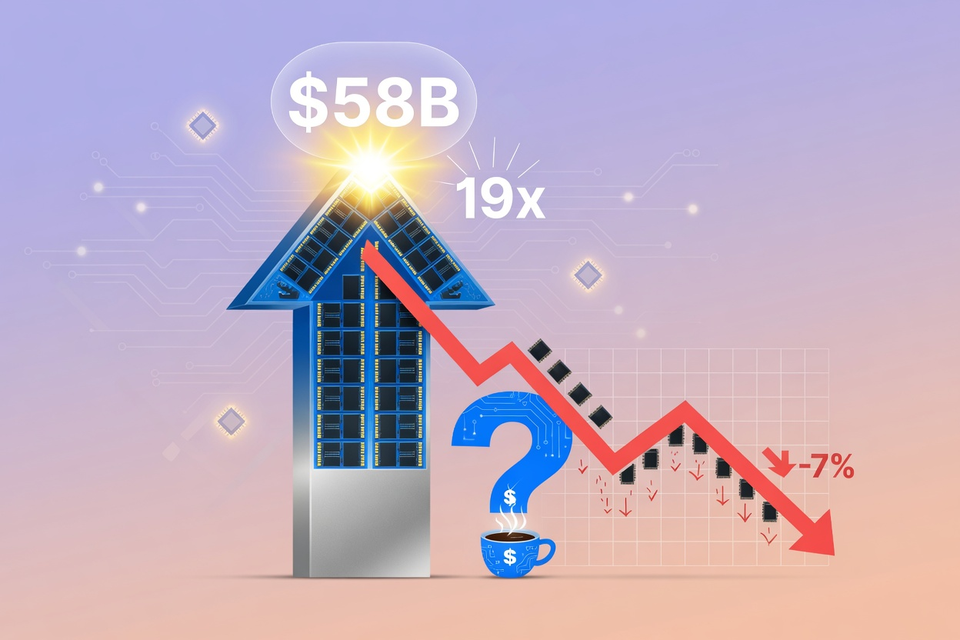
Here is a puzzle to enjoy with your morning coffee: Samsung posted a preliminary quarterly operating profit of about 58 billion dollars, a 19-fold jump from a year earlier, and its shares fell 7%. The rest of the memory complex followed it down. If that feels backwards, you now understand how expectations work on Wall Street, and I say that as someone who once celebrated a test score my father called two points short.
24/7 Wall St. reports the damage plainly: Micron down 7% to $917, SanDisk down 7% to $1,616, Western Digital down 7% to $537, and Seagate off 5% to $822. The Roundhill Memory ETF, a basket that holds the whole neighborhood, slid 6%.
The mechanism is worth understanding because it will happen again. These stocks came into the week as the year's runaway trade. Micron had gained 245% for the year, Western Digital 235%, Seagate 216%, and SanDisk 635%, a figure I have now typed three times because I keep assuming it is a mistake. When a stock is priced as if every quarter will be perfect, a merely excellent quarter reads as bad news. Deutsche Bank framed Samsung's record as "only" 6% ahead of estimates, and that word carried more weight than the 58 billion did.
Yahoo Finance puts the pullback in harder terms: Micron, Samsung, SK Hynix and that same memory ETF have each fallen more than 20% from recent closing highs, which is the textbook definition of a bear market. By its count, semiconductor names have shed roughly 1.5 trillion dollars in market value since June 25, with Micron alone accounting for nearly 350 billion of it.
None of that changes what the machines underneath are doing. Micron's most recent quarter brought in $41.46 billion in revenue, up 346% from a year earlier, at an 85% gross margin, and the company has guided its next quarter to around 50 billion. The high-bandwidth memory that AI accelerators depend on, the stacked kind that sits right beside the processor so data barely has to commute, remains supply-constrained, with the bottleneck expected to persist through 2027 according to the same reporting.
So the argument is not about whether memory makers are earning money. They demonstrably are, at rates that would have sounded like typos two years ago. The argument is about what price those earnings deserve, and analysts split on it in real time: UBS and Bank of America called the drop a "healthy reset" within a longer memory supercycle rather than a structural break.
A reset, though, is only healthy for the people who kept some cash on the sidelines. For everyone else, this week is a reminder that the sector's economics and the sector's stock prices are two different animals that occasionally take walks in opposite directions. The profits are record-sized. The patience, for one Tuesday at least, was not.




Leave a Reply