
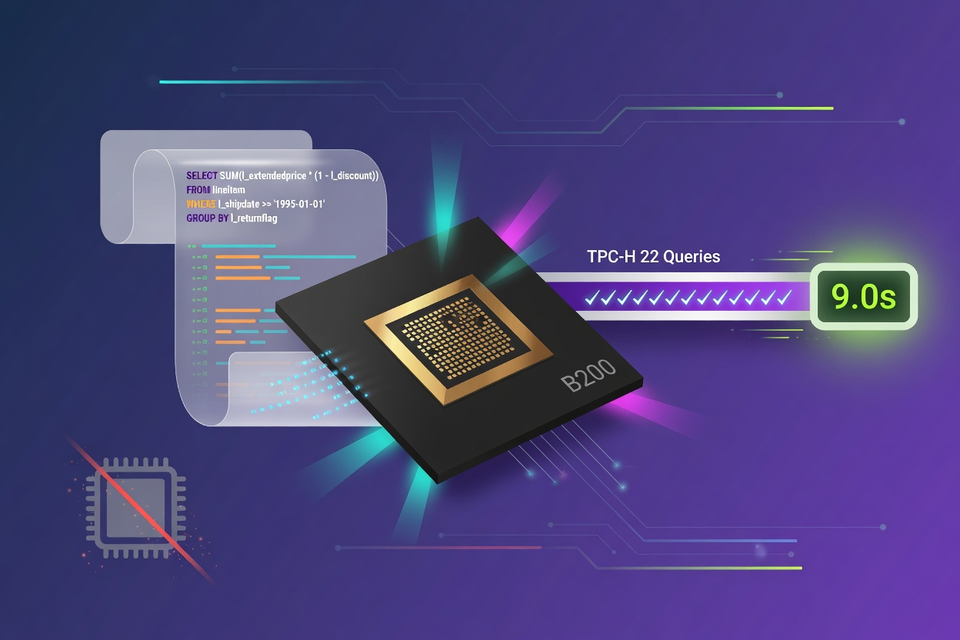
Almost every database in the world speaks SQL, and for most of computing history the machine answering it has been a CPU. NVIDIA has published a reference design that hands the job to a graphics chip instead. It is called GQE, for GPU Query Engine, and on the company's own bench a single Blackwell B200 worked through all 22 queries of the TPC-H benchmark in 9.0 seconds.
TPC-H is the standard homework assignment for analytics databases, 22 awkward questions asked of a synthetic warehouse full of orders and shipments. At the one terabyte size, NVIDIA reports the open-source database DuckDB taking 74.0 seconds on one socket of an AMD Turin Epyc 9755 and 70.6 seconds across both. The company puts the aggregate gain at 7.5 times on total execution time, with individual queries reaching as much as 25.5 times.
Two ideas carry most of that, and neither is about arithmetic. The first is refusing to move data nobody asked for. GQE chops a table into partitions of ten million rows by default and records the smallest and largest value in every column of every partition, a summary the engine calls a zone map. Think of it as the label on a storage box: ask for shipments from March, and the boxes marked September never leave the shelf. Across the 22 queries that skipped 31 percent of the data and delivered a 1.43 times end-to-end speedup, for an overhead NVIDIA measures at an average of 2.2 milliseconds.
Compression does the rest, and here the silicon matters. Blackwell carries a Decompression Engine, a dedicated block whose only job is unpacking compressed data so the general-purpose cores never stop to do it. NVIDIA measures it at up to 400 gigabytes per second in database work. At a four to one compression ratio that yields roughly 400GB/s of effective throughput from host memory into the GPU while leaving 100GB/s of link bandwidth free for other traffic.
Read the test conditions before the number. GQE's parameters were tuned per query, including the degree of parallelism and how the physical plan was built. The dataset was arranged to suit the technique, with the two largest tables clustered on their date columns and partitioned by month. Each query was averaged over five hot-cache runs. The post carries its own disclaimer, saying the results derive from the TPC-H benchmark but do not comply with the TPC-H specification and are not comparable to published TPC-H results.
Against DuckDB, GQE came out ahead on 20 of the 22 queries and reached three times or better on 17, with the widest margins on queries 11, 14 and 15, where pruning and compression cut the most data movement.
What NVIDIA is shipping is not a database. GQE is an open-source reference architecture built on the company's cuDF and nvCOMP libraries, and it accepts query plans in Substrait, an open format that lets an existing engine export a plan and run it here to see what the hardware would make of it. The pitch aims at the people who build query engines rather than the people who run them, and the argument is that a database redesigned around this hardware would go further than one merely ported to it.


Leave a Reply