
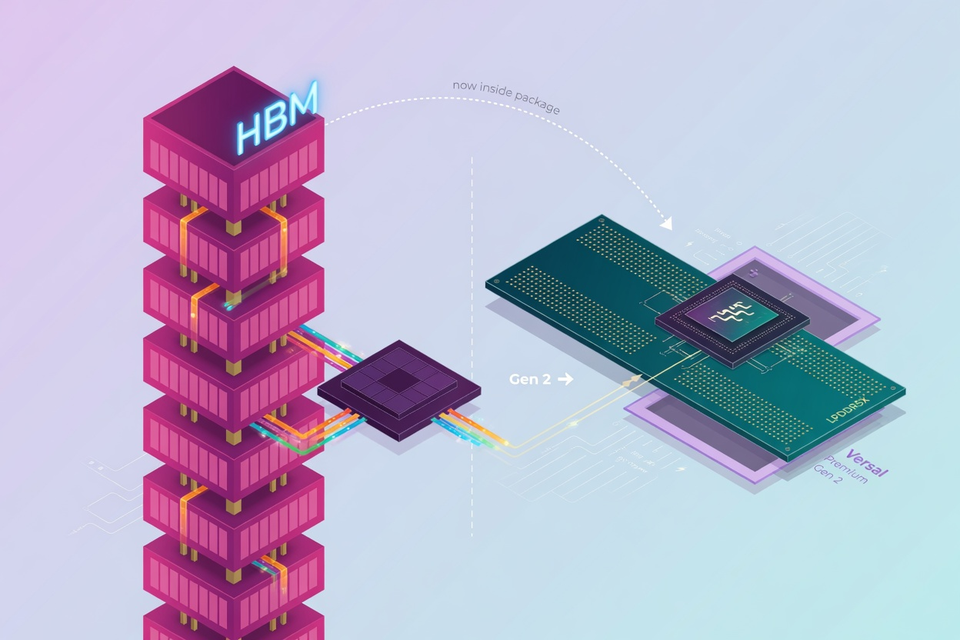
AMD has stopped putting high-bandwidth memory next to its programmable chips. The company announced the Versal Premium Gen 2 Memory on Package family, adaptive system-on-chips that carry up to 32GB of LPDDR5X inside the package instead of the stacked HBM its two previous generations used. Say HBM letter by letter. Picture an apartment tower for data, floors of memory stacked straight up beside the processor so the commute stays short. LPDDR5X is the flat, low-power memory in a phone.
Height buys bandwidth, and giving it up costs some. Versal HBM parts reached 819GB per second across 32GB of memory, ServeTheHome reports. The new memory-on-package devices hold the same 32GB and move up to 288GB per second. Same capacity, roughly a third of the speed.
Supply is what moved. SK hynix alone made the first generation of HBM, Samsung and Micron came in at HBM2, and the standard ran through three major specifications in its first nine years. AMD began discontinuing the Versal HBM series in September 2025, once HBM2e lines started converting to HBM3, and the order book on those chips closes on the day this announcement lands.
ServeTheHome's Ryan Smith puts the shift plainly: "In short: HBM is out, and LPDDR5X is in."
Two things get easier for AMD here. Stacked memory needs chip-on-wafer-on-substrate assembly and a silicon interposer, itself a bottleneck; LPDDR5X sits on ordinary organic packaging. And because the existing Versal Premium Gen 2 silicon already carries a 256-bit DDR5 and LPDDR5X controller, no separate die has to be fabricated for the memory-on-package version.
The compact result measures 55mm by 57.5mm, small enough for OCP NIC cards, half-height half-length PCIe cards, EDSFF, and the 3U VPX chassis used in defense gear. AMD puts the board-area saving at up to 60 percent against a monolithic Gen 2 part with external memory, a figure from its own April measurements rather than an independent test. Industrial temperature grades exist for LPDDR5X and never did for HBM, so these parts run from minus 40 to 110 degrees Celsius.
Three SKUs are on the list, the 2VP3422, 2VP3522 and 2VP3622, each with 32GB. All integrate CXL 3.1 and PCIe 6.0 at 64Gb/s in hard IP, and AMD offers 15-plus-year support on them, which is the quiet joke in the whole announcement: the memory from a phone is the one that stays available.
Sumit Shah, who heads product management and marketing for AMD's Adaptive and Embedded Computing Group, describes the change as removing a tradeoff system architects used to face between the memory bandwidth they wanted and the space, power and longevity their programs could live with. If AMD holds to its schedule, sampling starts at the end of this year and production shipments follow in the second half of the next.




Leave a Reply