
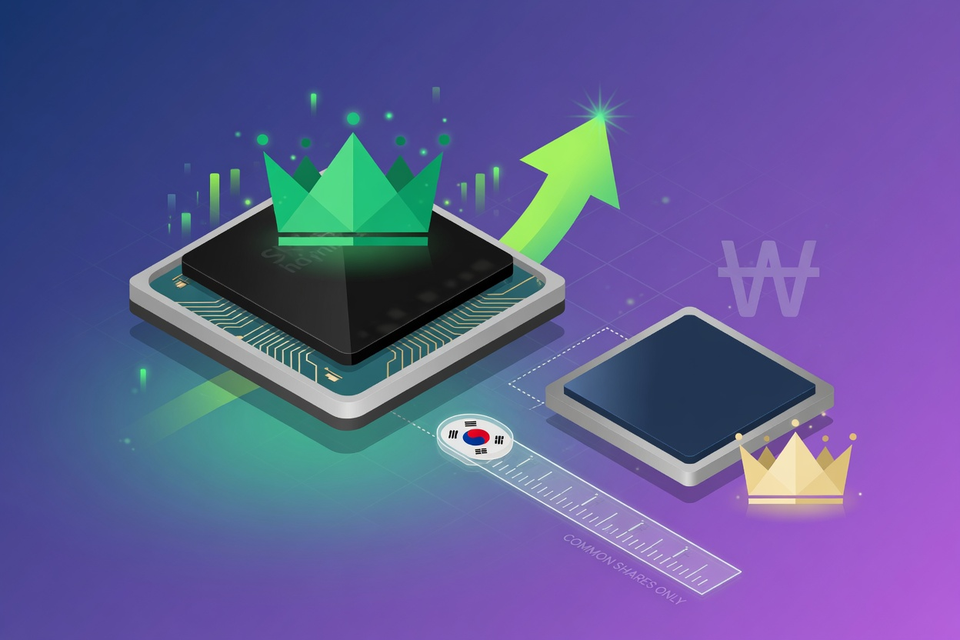
SK hynix overtook Samsung Electronics to become South Korea's most valuable listed company on Monday, and the size of the win depends entirely on which class of Samsung stock is being counted.
Shares closed up 5.6 percent at 2,919,000 won, having touched a 6.5 percent gain at 2,945,000 won during the session, according to KED Global, which records the move as an eighth consecutive session of gains. That much every source agrees on.
The market capitalisation figures are another matter. RTE, carrying the Reuters wire, reports SK Hynix at 2,082.5 trillion won, or $1.35 trillion, against 2,081.3 trillion won for Samsung excluding preferred shares, with Samsung up 0.4 percent. Stocktwits, covering the same session, puts SK Hynix at 2,080.4 trillion won and Samsung at 2,066.7 trillion won, with Samsung down 0.1 percent.
Those two accounts do not describe the same market. One shows a lead of 1.2 trillion won, under a tenth of a percent, with both stocks rising. The other shows a lead more than ten times wider and Samsung falling. Neither pair belongs in the record as settled fact until an exchange-side figure adjudicates them, and the dollar value is the only capitalisation number on which the two converge.
The share-class point is sharper than the arithmetic. Samsung said any calculation of its market capitalisation should include preferred shares, which would put the company near 2,252 trillion won. On that basis Samsung remains comfortably in front, and what changed hands is a common-share crown rather than a valuation crown. Samsung had held the top spot since 2000, so the caveat is doing real work.
High bandwidth memory is the mechanism underneath. By 2025 SK Hynix held 61 percent of the HBM market against Samsung's 17 percent and Micron's 21 percent, on the Reuters account carried by RTE. HBM is where memory stopped being interchangeable, and pricing power followed the moment substitution stopped being an option for accelerator builders.
The read-across to US listings was immediate. The Roundhill Memory ETF rose nearly 3 percent in premarket trading and has gained 163 percent since its April 2 launch, per Stocktwits, with SK Hynix, Samsung and Micron as its three largest holdings. Western Digital led the American names on 5.2 percent, with Seagate at 4 percent and SanDisk at 3.6 percent.
Micron reports fiscal third quarter results on June 24, the next hard datapoint in a sector currently being repriced on share moves rather than on shipped bits.
One structural caution is worth stating plainly. A single vendor holding three fifths of HBM supply is a concentration risk for every accelerator programme that depends on it, and the equity market is pricing that concentration as an unambiguous positive.
Bootnote: SK Hynix traded as low as 135 won in 2003, when the company was still Hynix Semiconductor and sat under creditor control after a sale to Micron collapsed the previous year. It posted an operating loss of 7.73 trillion won as recently as 2023.



Leave a Reply