
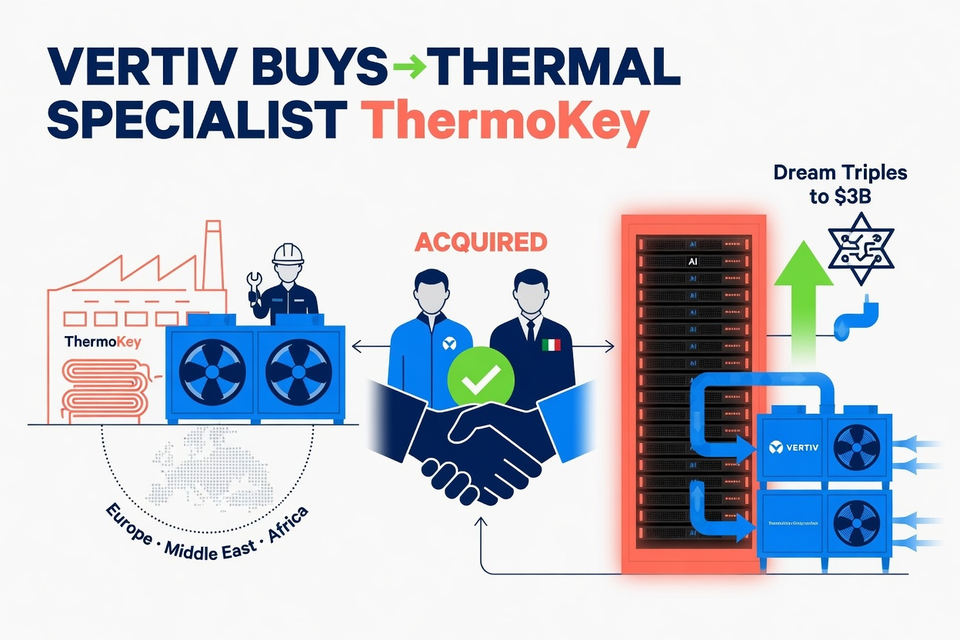
Vertiv has closed its purchase of ThermoKey, an Italian heat-exchange specialist that has spent three decades building dry coolers and heat-rejection gear for equipment makers and system integrators across Europe, the Middle East and Africa. Folding that engineering into Vertiv's own thermal management lineup gives it a fuller chain of cooling hardware for data halls that are running hotter as AI racks pack more compute into less floor space.
"Customers are scaling AI infrastructure at an unprecedented pace, and thermal performance is now a critical enabler of capacity and efficiency," said Giordano Albertazzi, CEO at Vertiv. "With ThermoKey, we are strengthening our capabilities to deliver differentiated, integrated, high-performance heat rejection solutions that help customers deploy faster, operate more efficiently, and scale with confidence."
Giuseppe Visentini, ThermoKey's chief executive, stays on to run the unit from its home base in Rivarotta, Italy, where manufacturing and engineering work will continue. "Joining Vertiv means bringing our heat-exchange expertise into a complete, integrated thermal chain that serves high-density data centers," he said. "We share Vertiv's engineering rigor and customer focus."
Capital kept finding AI ventures elsewhere this week too. Dream, a Tel Aviv-based firm building AI and cybersecurity tools for governments, raised $260 million at a $3 billion valuation, nearly tripling the value investors put on it roughly sixteen months ago. Bicycle Capital and Group 11 co-led the round, joined by Bain Capital Ventures, Antler and Tru Arrow Partners. Shalev Hulio, Sebastian Kurz and Gil Dolev founded the company in January 2023, and it has now raised $412 million in total.
"We started three and a half years ago with the vision that the next cyber warfare is going to be AI versus AI and not human versus human anymore," Hulio told The Times of Israel. He argues governments cannot simply hand their most sensitive material to an outside cloud provider. "Governments have huge amounts of data, and they want to use AI, but they can’t take their entire data and upload it to ChatGPT or upload it to Claude or Gemini because it’s sensitive information," said Hulio.
Kurz, the former Austrian chancellor who co-founded the company, frames the pitch in similar terms. "Nations that want to control their future need the ability to operate advanced AI under their own authority, on infrastructure they govern, and in alignment with their own interests," said Kurz. Dream built its own data center near Modiin earlier this year specifically so that client governments' data never has to leave infrastructure they control.
Sales at the company have more than doubled over the past two years to $300 million, and it now employs 350 people, 300 of them in Israel. Hulio said the fresh capital will go toward acquisitions, hiring and an expansion into the United States and deeper into Europe.




Leave a Reply