
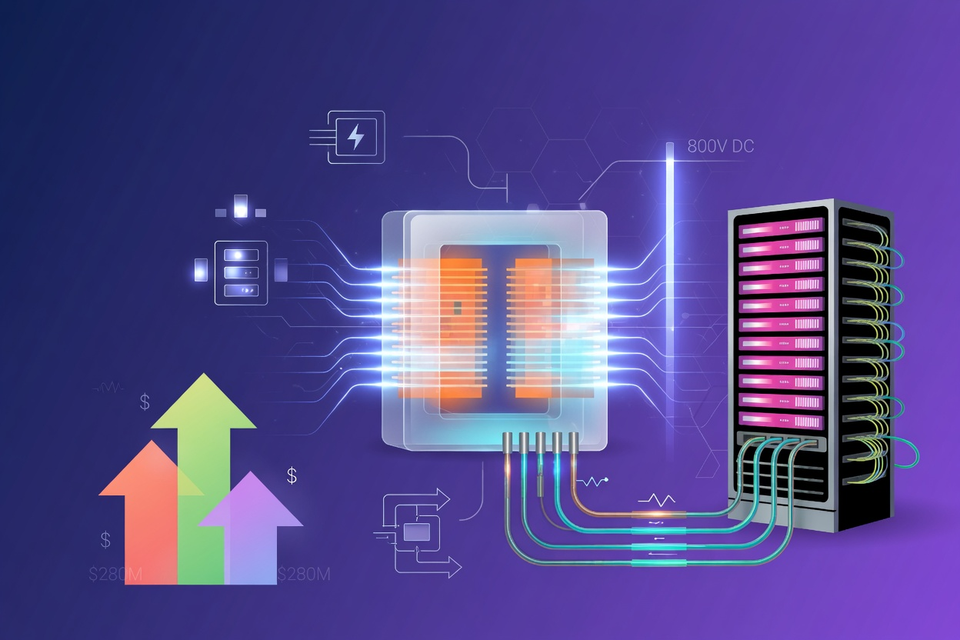
DG Matrix closed a $60 million Series A in February 2026, led by Engine Ventures with participation from Mitsubishi Heavy Industries and ABB, taking its total raised past $100 million. The company builds solid-state transformers, and it is one of three specialists that have pulled in a combined $280 million over the past year as operators start rebuilding the data center power chain around AI racks.
Heron Power closed a $140 million Series B in February 2026, co-led by Andreessen Horowitz's American Dynamism Fund and Breakthrough Energy Ventures. Amperesand raised an $80 million Series A in November 2025, co-led by Walden Catalyst Ventures and Temasek, and is targeting 30 megawatts of commercial deployments in 2026. Data Center Richness, which reports the tally, places all three inside the shift toward 800 volt DC distribution that Nvidia and its partners are driving for next-generation AI infrastructure.
A solid-state transformer swaps the copper or aluminum windings and steel core of a conventional unit for power semiconductors, mostly silicon carbide or gallium nitride, plus software control logic. It still converts voltage, but it also routes power from several sources at once, responds to load changes in milliseconds, integrates battery backup without separate UPS hardware, and provides real-time grid stabilization. Data Center Richness says such systems can cut electrical equipment footprint by 70 to 80 percent, because layers of switchgear, distribution transformers and UPS hardware collapse into one device.
"The transformer hasn’t fundamentally changed in 100-plus years," said Haroon Inam, founder and chief executive of DG Matrix, who characterizes the conventional design as windings around a steel core built for a single purpose. By his account it works well enough when a server rack pulls 5 kilowatts and the workload is predictable.
Inam sets that against what an AI hall now asks of the same equipment. "It doesn’t work when a single NVIDIA MGX rack demands 600 kilowatts, swings from idle to full load in microseconds, and sits behind a grid interconnection queue that’s three to five years long."
Buyers should read the maturity carefully. Data Center Richness describes SSTs as an emerging technology moving out of the lab and pilot stage into prototypes and first commercial offerings, and says broad deployment will require operator comfort at data-center scale. No shipping volumes, unit pricing or commissioning times appear for any of the three companies, and none is credited with a data center reference at scale.
Incumbent power vendors have already bought in. Eaton completed its acquisition of Austin-based Resilient Power Systems in August 2025, bringing medium-voltage SST technology in-house, and Enphase Energy and SolarEdge have both launched SST products aimed at AI data centers. That gives a buyer a route to the technology through an established supplier rather than a Series A startup, which matters where procurement requires a service organization and a spares chain.
For anyone sizing a hall above roughly 100 kilowatts a rack, the practical question is whether the transformer supply queue or the interconnection queue binds first, because an SST addresses the first and not the second. Nothing here is orderable at volume today, so the near-term move is to ask the incumbent vendors already on a bid list what their SST roadmap is and when they expect to quote it.

Leave a Reply