
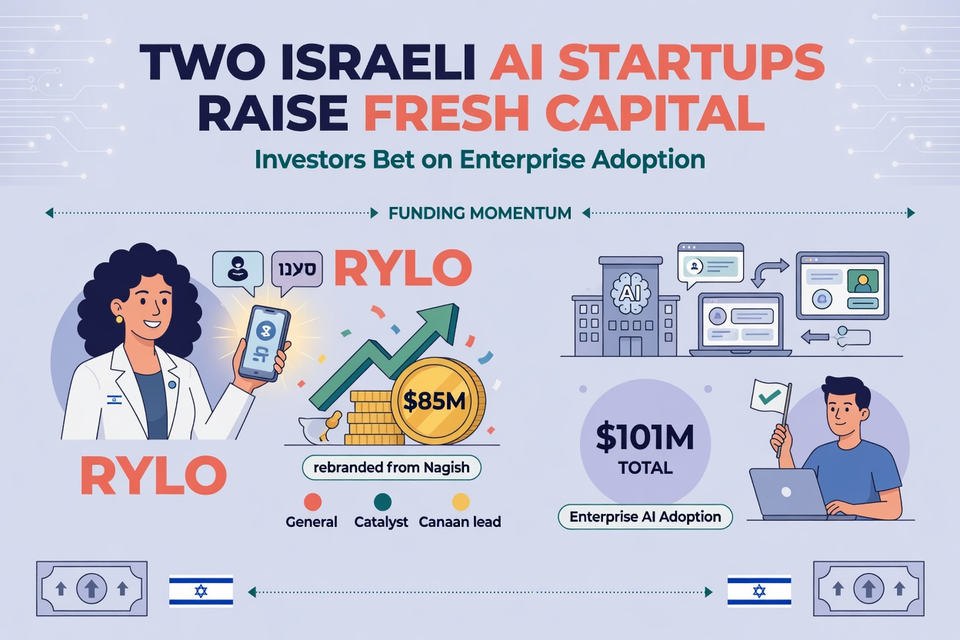
Rylo, an Israeli startup that rebranded from Nagish, has raised $85 million at a valuation of roughly $500 million. General Catalyst and Canaan led the round, with existing backers Cardumen, Vertex Precursor and K5 also participating. The company had previously raised just $16 million, bringing its total funding to $101 million.
Founded in 2022 by Tomer Aharoni and Alon Ezer, Rylo builds AI-powered speech-to-text and text-to-speech technology for deaf and hard-of-hearing users, letting people make phone calls without relying on human-staffed relay centers. The platform supports 50 languages, though Rylo currently focuses on the U.S. market, where an estimated 40 million people are deaf or hard of hearing.
A Federal Communications Commission license, one of only six issued for this kind of service, underpins the business. It lets Rylo draw compensation from a federally funded program rather than billing users directly, at rates of $1 to $8 per minute set by regulators every three years. Since receiving the license in May 2024, the company says it has grown revenue 400% over the past year and expects to reach $100 million in annual revenue by the end of 2026.
"At our current run rate of $100 million in revenue, we've only penetrated about 1% of the U.S. market," Aharoni said. Rylo employs just 32 people, about half of them in Israel, and Aharoni said the company turned profitable shortly after its first revenue. It aims to reach $1 billion in annual revenue by 2028, partly through Sign.mt, a sign-language translation startup it acquired at the end of 2025.
A second Israeli company, Jedify, closed a $24 million Series A led by Norwest, with Snowflake Ventures joining as a strategic investor alongside existing backers S Capital VC and Cerca Partners and new investor Oceans Ventures. Norwest partner Assaf Harel will join Jedify's board. The round brings the three-year-old company's total funding above $33 million, following an $8.5 million seed round in 2023.
Its founding team, chief executive Assaf Henkin, chief technology officer Adi Elimelech and chief product officer Erik Shani, built the business around what it calls a context graph: a continuously updated model that links structured data from CRMs and financial systems with unstructured sources such as documents and chat messages. The pitch addresses a familiar complaint about enterprise AI, that large language models keep improving while most deployments stall in prototype because they lack reliable context about how a business actually runs.
"In order for an agentic workflow to really work well for an enterprise at scale, it needs a very deep understanding of that business," said Henkin. "Enterprise data is fragmented across systems, definitions, permissions, and workflows."
Both rounds land in a funding environment where investors increasingly back narrow, infrastructure-layer bets over general-purpose model companies, wagering that the gap between what AI can do and what organizations can actually deploy is where the money gets made.


Leave a Reply