

The most expensive part of an AI server is starting to be the part nobody puts on the slide. Dell'Oro Group, a market research firm that tracks what the world's biggest cloud operators spend on their buildings and their boxes, has raised its outlook for worldwide data center capital expenditure in 2026 to more than $1 trillion, and it credits a large share of that increase to the price of memory and storage.
Capital expenditure, shortened to capex and said as two ordinary syllables rather than spelled out, is the money a company sinks into things it will still own in five years. Land, transformers, switches, cooling plant, and rack after rack of servers. It is the least glamorous number in the industry and one of the more honest ones, because it records what an operator actually did rather than what it announced.
"Rising memory and storage pricing substantially increased overall server system costs in the quarter and will likely remain a major capex growth factor this year," said Baron Fung, Senior Research Director at Dell'Oro Group.
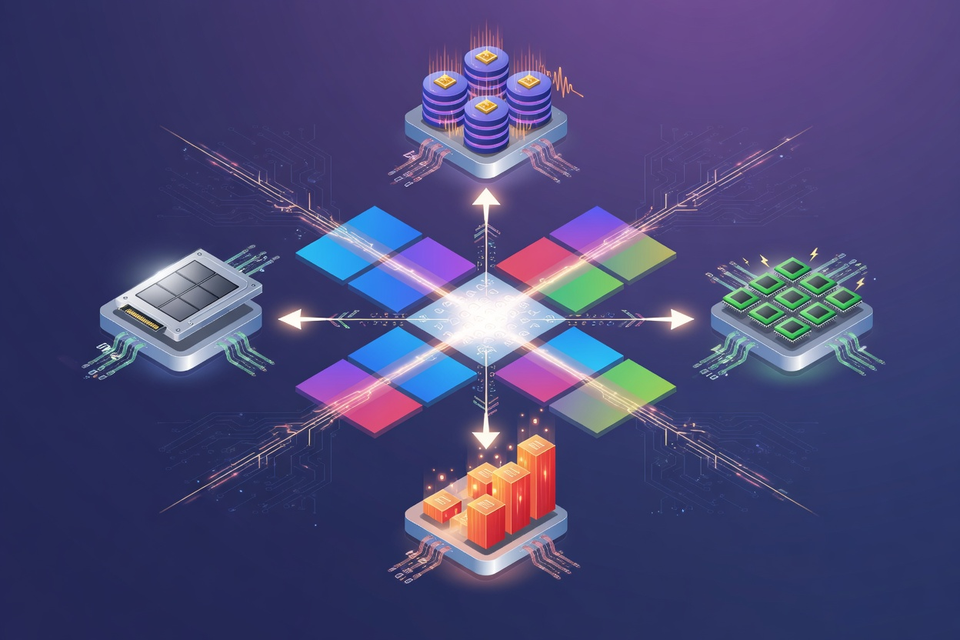
That sentence carries more weight than it looks. A server is a bill of materials, and for years the processor was the line that mattered while the memory and the flash storage were the rounding error you argued about at the end. Invert that. When the memory in a machine gets dearer, the whole machine gets dearer, even if the design never changed and the chip inside it is the same one you were quoting last year. Think of a building where the price of concrete doubled halfway through the pour.
Dell'Oro puts the increase in data center capex at the four large US cloud providers, which it names as Amazon, Google, Meta and Microsoft, at 78 percent. The release does not state what that figure is measured against, so treat it as the firm's own reading of its own tracker rather than a comparison you can rebuild yourself.
On the supply side of that spending, the firm says Dell led server original equipment manufacturer revenue in the quarter, ahead of Supermicro and Lenovo, while the white box builders that sell straight into hyperscale accounted for most server revenue overall. Nearly all server vendors, it adds, benefited from higher memory-driven system pricing. That is a polite way of saying the vendors are shipping roughly the same iron for more money.
What happens next is a projection rather than a result. "While near-term demand remains healthy, some spending may have been pulled forward ahead of expected price increases later this year," explained Fung. If that pull forward is real, some of the strength in the current numbers would be borrowed from later ones, and the firm expects growth to pick up again in the second half as NVIDIA's Rubin systems ramp and hyperscalers refresh their own custom accelerator platforms.
One caveat belongs on the front of all of this rather than buried at the back. These figures come out of a paid quarterly report, Dell'Oro's Data Center IT Capex Quarterly Report, and the release does not publish the methodology behind them. What would settle the number is the operators' own filed capital spending, which arrives on a slower schedule and in a different shape. Until then the trillion dollar line is a research house's estimate with a research house's name on it, which is worth exactly that and no more.

Leave a Reply