
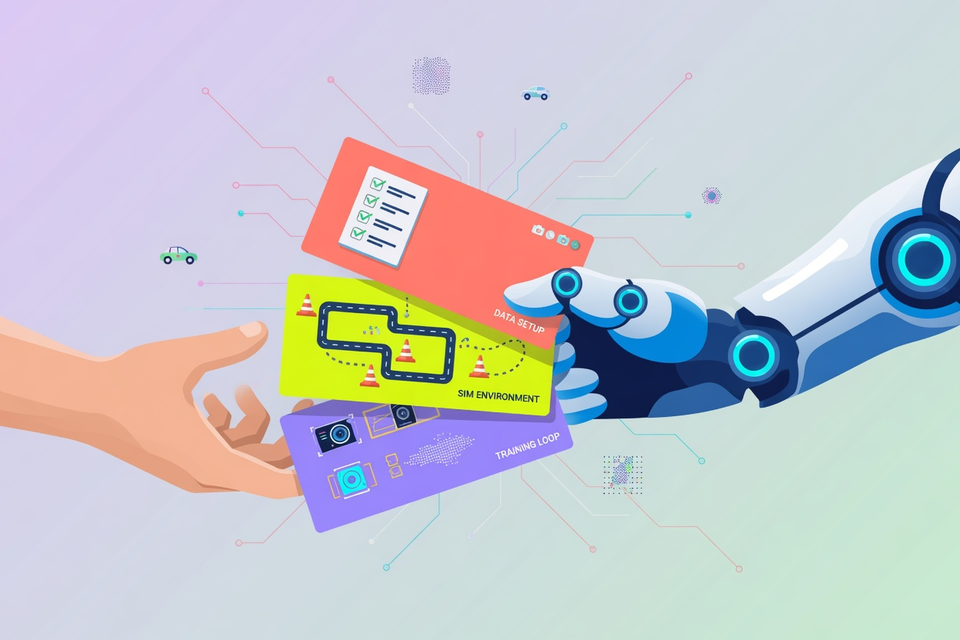
The least glamorous truth in robotics research is that most of the work is not teaching the robot, it is setting up the classroom. NVIDIA is aiming squarely at that chore with new physical AI agent skills, unveiled for the CVPR computer vision conference, that let researchers hand the tedious parts of autonomous vehicle, robot and vision AI development to AI agents.
Physical AI, in plain terms, is AI that has to work in the world of gravity and traffic rather than in a chat window, and NVIDIA's pitch is that the bottleneck there is workflow rather than model quality. Reconstructing real scenes, generating rare scenarios, training a policy, evaluating it and starting over currently means stitching together separate tools by hand. The new skills package those steps so an agent can run them, paired with Cosmos 3, the world foundation model NVIDIA announced days earlier and describes as the first full omnimodel unifying vision reasoning, world generation and action generation.
For self-driving researchers, the target is the long tail, the rare events no fleet collects often enough to learn from. Neural Reconstruction skills turn fleet-captured footage into editable 3D scenes, so a recorded near-miss can be replayed with the lighting changed, the geometry rearranged, or the pedestrian a step closer. A world model, if the term is new, is software that predicts how a scene evolves, letting simulations respond believably instead of playing back a recording. NVIDIA's Cosmos-Dreams adds photorealistic frames that react to a policy's actions in real time, and AlpaGym, an open source reinforcement learning framework, scales the whole train-and-evaluate loop across thousands of GPUs.
The company also released what it calls its most powerful open driving foundation model to date, Alpamayo 2 Super, a 32-billion-parameter model of the type researchers call a VLA, for vision language action, meaning it reads the road, reasons about it and outputs driving decisions in one system.
Vision AI teams get their own version of the same medicine. New Metropolis skills generate synthetic anomalies, the rare defects and odd events inspection models must catch but real production lines mercifully seldom supply. Factory inspection researchers can conjure scratched surfaces and misaligned parts across materials using real images as seed stock.
Robotics researchers, meanwhile, can task agents to author scenes, launch simulations, capture data and set up reinforcement learning runs across NVIDIA's Isaac Sim and Isaac Lab frameworks.
The competitive logic is familiar. Every one of these workflows runs on NVIDIA simulation libraries and NVIDIA GPUs, so making researchers faster also makes them more thoroughly NVIDIA's. The bet being placed is that whoever automates the research grind ends up owning the platform the breakthroughs happen on, and with these skills the company is making that bet with tooling rather than talk.


Leave a Reply