

Gallium nitride spent most of the last decade making phone chargers suspiciously small. It is now being asked to do something less charming, which is to stop AI data centre power supplies from wasting quite so much of what they are fed. Cyient Semiconductors has launched seven power devices built on the material, its first commercial family in the category, developed under a licence from Navitas Semiconductor.
A quick word on the material, because the acronym gets mangled. Gallium nitride is shortened to GaN, and engineers say it like the back half of "began", not as three letters. Picture a power switch as a tap that has to open and shut tens of thousands of times a second. Silicon is a heavy brass tap that works fine but sheds a little heat on every turn. GaN is lighter and snaps shut faster, so less of the energy passing through leaks away as warmth. Cyient's release puts the same idea in trade language, citing higher switching speeds, lower conduction losses and better thermal efficiency against silicon.
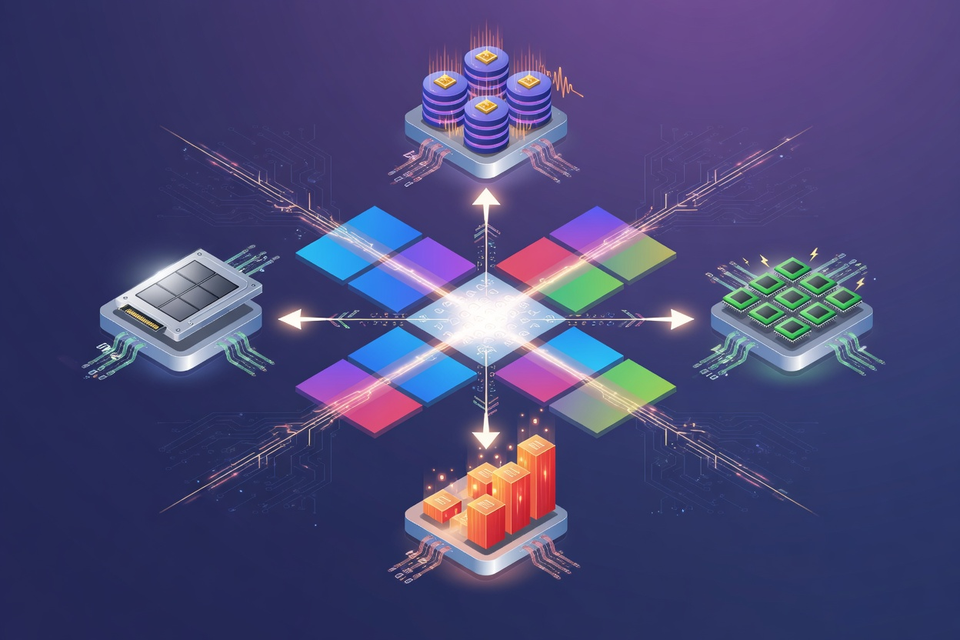
The parts themselves are rated at 700 volts and arrive in DPAK packages, the squat plastic housing that sits flat against a circuit board. Each one folds the driver, control, protection, EMI management and current sensing onto the same device rather than leaving them as separate chips around it. On-resistance, roughly the toll the switch charges for staying open, spans 120 to 330 milliohms across the seven. Two of them come in variants tuned for different power supply topologies.
Cyient says the initial portfolio targets power applications up to 650 volts, a list that runs from USB-PD chargers and laptop adapters through AC-DC supplies to telecom and AI data centre power systems and e-mobility charging. That is a wide net for a first family, and the 700-volt rating against a 650-volt target is the usual headroom engineers ask for.
Suman Narayan, chief executive of Cyient Semiconductors, said: "This represents the foundation of a broader GaN portfolio that will address the growing power and efficiency demands of AI infrastructure, industrial systems, consumer power, and e-mobility applications".
The clause worth pausing on sits lower in the announcement. Under the licence, Cyient will also act as a second source for selected Navitas devices already in mass production. A second source is simply another factory a buyer can order an identical part from when the first cannot deliver, and after four years of everyone discovering how much they disliked single-sourced silicon, it is a real selling point rather than a footnote.
What has not happened yet is manufacturing. The company describes a phased path, expanding the range through local assembly and test partners first, with domestic production of GaN devices in India presented as something the licence enables over time rather than a dated commitment. The collaboration behind all this was announced in December 2025.
Sampling of the first parts is expected by June 2026. No pricing appears anywhere in the announcement, which for a family pitched partly at high-volume charger makers is the number that will decide whether any of this matters.


Leave a Reply