
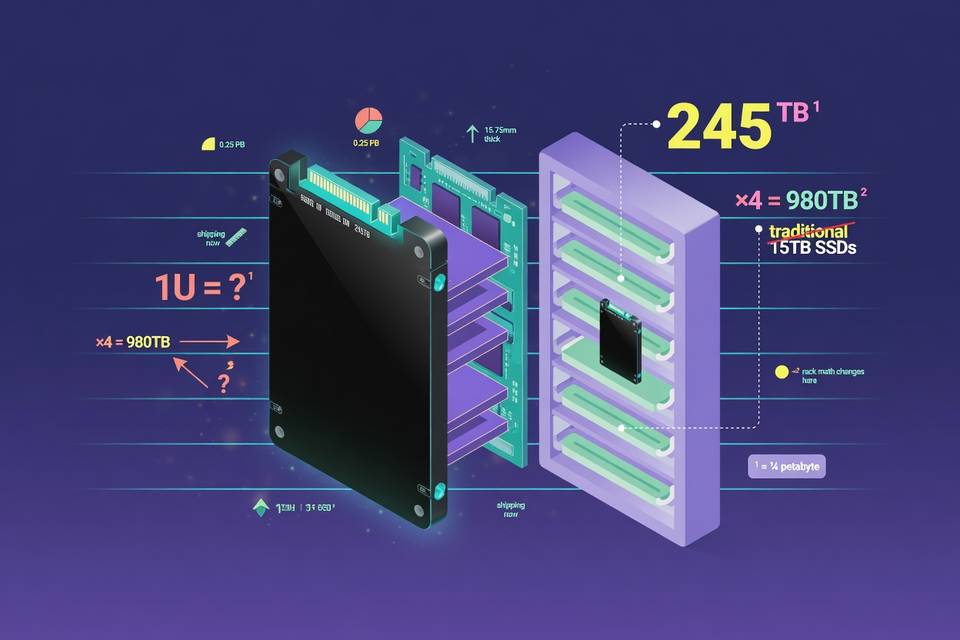
Micron has started shipping a solid state drive that holds a quarter of a petabyte. Micron says the 245TB 6600 ION is now in customers' hands and describes it as the world's highest capacity commercially available SSD. The capacity is the easy part. The arithmetic stacked on top of it is what rewards slowing down.
First, the flash. The drive is built on Micron's G9 QLC NAND, and QLC stands for quad-level cell, which means each memory cell stores four bits rather than one. Think of a parking space that takes four motorbikes instead of one car. You fit far more into the same footprint, and the price is that getting each one in and out takes a little more care.
Now for the number that will end up in every slide deck. Micron says a deployment using the 245TB drive in the E3.L form factor needs 82 percent fewer racks than a hard-drive deployment holding the same raw capacity. The footnote makes the sum plain. Both sides of the comparison assume 720 drives per 36U, so the 82 percent is really the ratio between a 245.76TB SSD and a 44TB hard drive, which Micron puts at 5.6 to one, and the company labels the result a theoretical maximum.
Power gets the same treatment. The 245TB drive draws up to 30 watts at maximum power, which Micron says is half what a comparable-capacity hard-drive deployment consumes. The footnote concedes that power figures for 44TB hard drives are not published, so the comparison rests on peak power for 36TB and 32TB drives instead. That is a disclosed gap rather than a buried one, and knowing it matters before the number travels.
Then come the workload results, which are large. Micron reports up to 84 times better energy efficiency, 8.6 times faster AI preprocessing and 3.4 times better ingest throughput against hard drives, with up to 29 times lower latency. Who ran the test matters as much as the multiples. The work was done in Micron Engineering labs, setting one 245TB drive against an array of sixteen 16TB data center hard drives from a single manufacturer.
Jeremy Werner, senior vice president and general manager of Micron's Core Data Center Business Unit, puts it this way: "This breakthrough capacity gives data center operators a critical new lever to improve rack-level total cost of ownership, especially as power availability becomes a defining constraint for AI infrastructure scale."
That closing clause is the market Micron is chasing. Jeff Janukowicz, a research vice president at IDC, appears in the same announcement saying "Operators need more usable capacity per rack while staying within strict power and cooling constraints." It is a quotation the vendor picked for its own release, though the constraint it names is the one Micron is selling against.
The drive ships in U.2 and E3.L form factors. Dell is attached as well. Travis Vigil, senior vice president for ISG product management, says in the release that 245TB drives will go into Dell storage systems for AI. Scale the model up and Micron's own figures put an exabyte of storage at 4,069 of these SSDs against 22,727 hard drives.
One claim sits outside anybody's lab. Micron says its G9 QLC is at least one generation ahead of any competing QLC used in data center SSDs, and the stated basis is published data on the top five OEM data center SSD suppliers by revenue, drawn from a Forward Insights report. That is a reading of rivals' published specifications rather than a measurement of their parts, which is a fine place to leave it.



Leave a Reply