
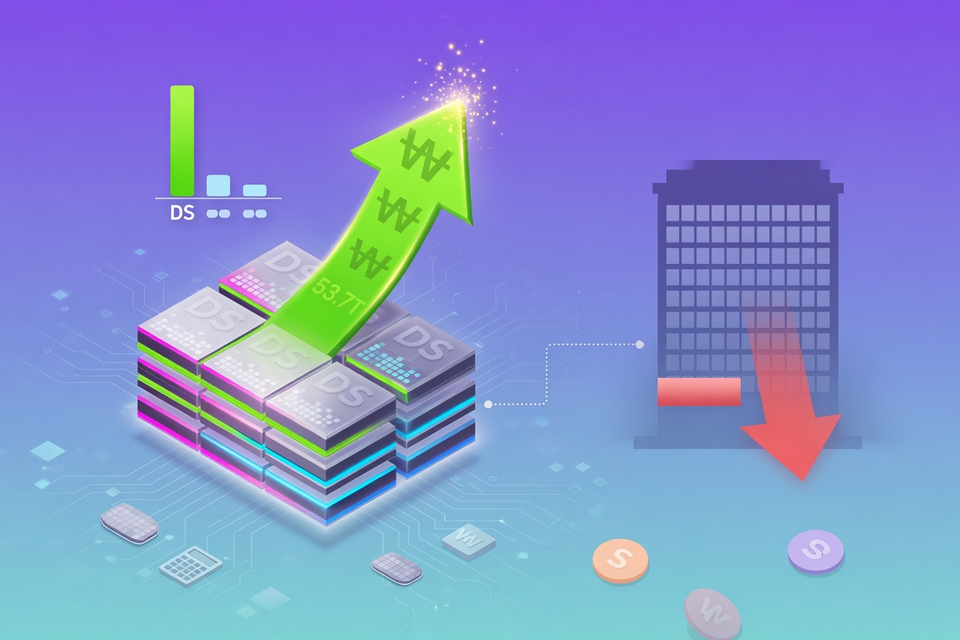
Samsung Electronics booked KRW 53.7 trillion of operating profit in its Device Solutions division in the first quarter, out of KRW 57.2 trillion for the entire group.
That is about 94 percent, a figure we calculated from the two numbers Samsung published rather than one the company disclosed. Group revenue was KRW 133.9 trillion, an all-time quarterly high and a 43 percent rise quarter on quarter. Operating profit also set a record. Against the year-ago quarter Samsung disclosed alongside its own first-quarter guidance, KRW 79.14 trillion of sales and KRW 6.69 trillion of operating profit, that works out at about 69 percent revenue growth and about 755 percent profit growth. Both are our arithmetic, not Samsung's.
The release is blunt about where that came from. "The Memory Business surpassed its quarterly sales record by addressing high-value-added AI demand despite limited supply availability, with industry-wide memory price increases also a contributing factor."
Read that again. The record was set on price, and the release names higher average selling price as a driver in the same breath as technology leadership. A seller describing constrained supply as the backdrop to its own record quarter is describing a shortage it is being paid for.
The bill is landing inside Samsung's own building. Samsung Display reported a decline in its small and medium display earnings that it put down to seasonal effects and the impact of higher memory prices. Harman, per the release, "posted an earnings decline in Q1 2026 due to increased expenses amid memory constraints and audio seasonality." Two divisions of the same company are now absorbing the pricing a third division is collecting.
On product, the claimed firsts include "initiating the industry’s first mass product sales of HBM4 and SOCAMM2 for NVIDIA’s Vera Rubin platform, as well as the timely development of PCIe Gen6 SSDs". Samsung says it is scheduled to deliver its first HBM4E samples in the second quarter. The foundry business, whose earnings fell on off-peak seasonality, says it is targeting improvement partly on increased HBM4 base-die supply, which is the useful detail here: the logic die under an HBM4 stack is a foundry product, so a memory ramp pulls two Samsung divisions at once.
NAND gets a narrower pitch. The memory business "plans to lead the initial PCIe Gen6 eSSD market with high-performance products focused on KV cache storage demand", which is Samsung selling flash into the inference tier rather than into general server refresh. If DRAM stays scarce and expensive, pushing cache state onto Gen6 SSDs is one of the few levers an operator has left.
Elsewhere the picture is ordinary. Device eXperience sales rose 19 percent quarter on quarter on new flagship phones, System LSI improved on SoC volume, and the foundry says 1.4nm development remains on track with second-generation 2nm mobile production planned for the second half. None of it moves the group number. Samsung is a memory company with a very large consumer electronics business attached, and this quarter it stopped pretending otherwise.
Bootnote: KV cache is the stored attention state a transformer keeps for tokens it has already processed, so it does not recompute them on every step. It is conventionally held in HBM or DRAM next to the accelerator, which is exactly the capacity that is now rationed and repriced, hence the sudden interest in spilling it onto very fast SSDs.



Leave a Reply