
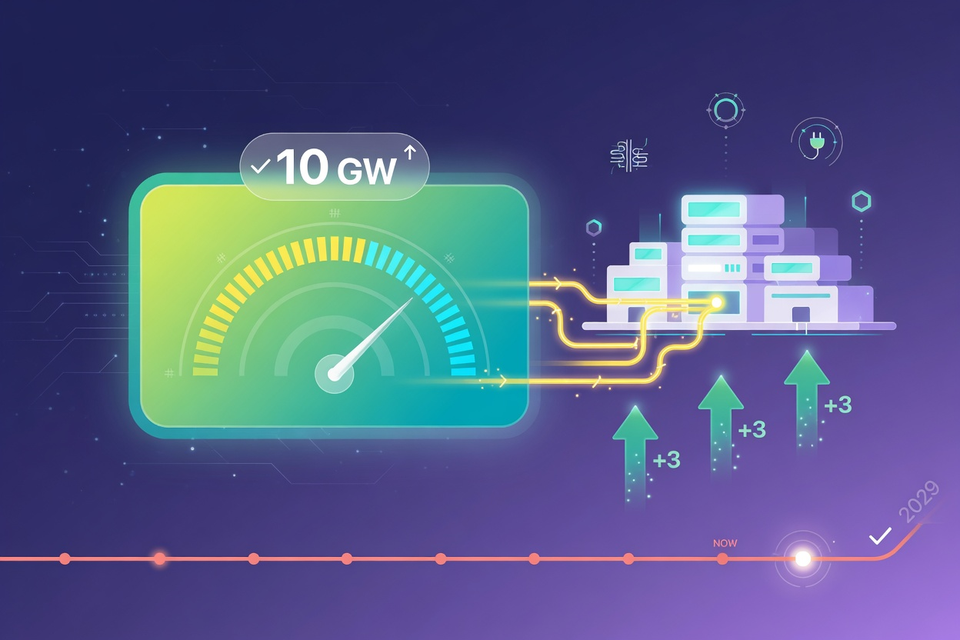
A gigawatt is one of those units that sounds like a movie prop until somebody actually tries to buy one. OpenAI says it has now secured more than ten of them for AI infrastructure in the United States, clearing a target it had set for 2029, with more than 3GW of that total added in the last 90 days.
Note the unit. Stargate, the company's compute buildout effort, gets counted in electrical capacity rather than in chips or floor space, because power is the thing that runs out first. Racks can be shipped and land can be bought. Persuading a utility to commit a gigawatt to one address is the part that takes years.
The company puts the original promise plainly: "When we announced Stargate in January 2025, we committed to securing 10GW of AI infrastructure in the United States by 2029." It now says it has "already surpassed that milestone". The tally is OpenAI's own, and no third party is named as having audited it.
Demand, not ambition, is how the post frames the acceleration, in OpenAI's own words: "The only responsible way to meet it is to build more compute, faster." The same post lists what actually gates a new site, and the list is gloriously unglamorous: "power, land, permitting, transmission, workforce, community support, and partner readiness".
Abilene, Texas is the site the company holds up as the model. GPT-5.5, which OpenAI describes as its latest and smartest model, was trained there, and the post states that "The site operates on Oracle Cloud Infrastructure and runs NVIDIA GB200 systems."
Water is where the numbers get specific and the verification gets thin. Abilene uses closed-loop cooling, so the same water circulates through sealed pipes instead of evaporating away, and OpenAI says "the one-time initial fill for each building is equal to roughly two Olympic-sized swimming pools". After that, it expects annual use for the whole cooling system at full buildout to be comparable to a medium-sized office building. No measurement method is given and no outside verifier is named, which is worth holding lightly.
Evidence that the demand is real sits in other people's accounts. Meta told investors it now anticipates 2026 capital expenditures in the range of $125bn to $145bn, raised from a prior range of $115bn to $135bn, and pinned the increase on "higher component pricing this year and, to a lesser extent, additional data center costs to support future year capacity."
That last clause is the uncomfortable bit. Buying more compute is what makes intelligence cheaper per unit, and buying it this fast is what is making the memory and the megawatts underneath it more expensive. If both trends hold, the thing standing between a model and its users would be a construction schedule rather than a research result.

Leave a Reply