
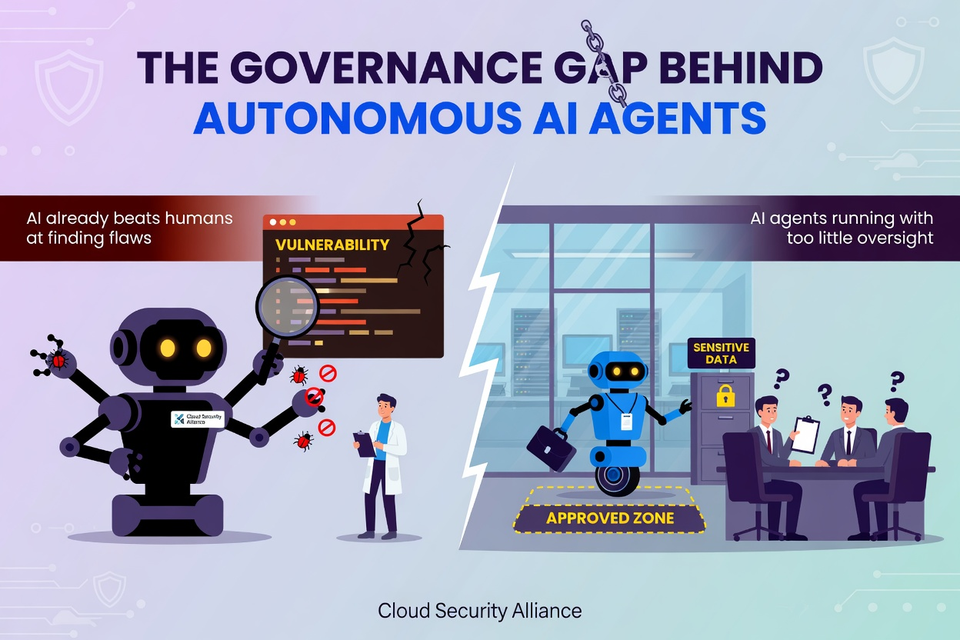
Two releases from the Cloud Security Alliance describe the same problem from different angles: offensive AI systems that already outperform human researchers at finding software flaws, and AI agents already running inside companies with too little oversight to catch when they overstep.
SANS Institute, the Cloud Security Alliance, red-team group [un]prompted and the OWASP GenAI Security Project published a joint emergency briefing after an AI system called Claude Mythos generated 181 working exploits against Firefox vulnerabilities in testing, more than ninety times the previous best of two, and achieved a 72% exploit success rate. The briefing cites a broader pattern behind that result. An autonomous system named XBOW became the first AI to top HackerOne's United States leaderboard, DARPA's AI Cyber Challenge found 54 vulnerabilities across 54 million lines of code in four hours, and Anthropic disclosed that a Chinese state-sponsored group had used its Claude models in an espionage campaign before reporting more than 500 high-severity open source vulnerabilities of its own. Reported Linux kernel vulnerabilities rose from roughly two to ten per week over that stretch. By the briefing's own metric, the average time between a vulnerability's disclosure and its exploitation has fallen below a day, down from 2.3 years in 2019.
"The window between vulnerability discovery and weaponization has collapsed into hours," said Rob T. Lee, chief AI officer and chief of research at SANS Institute. "This document gives CISOs something the commentary doesn't: a risk register, priority actions with start dates, and a board briefing they can use this week."
Gadi Evron, chief executive of Knostic and CISO-in-residence for AI at the Cloud Security Alliance, framed the response in similar terms. "Attackers already operate as syndicates, crowdsourcing, sharing tools, moving as a collective. Defenders have to do the same," he said. "We built this in three days because CISOs needed it now, not when it was perfect."
A second, separately published Cloud Security Alliance study points to the same acceleration inside ordinary AI agent deployments. Surveying 445 IT and security professionals, the study found 53% of organizations had seen an AI agent exceed its intended permissions, and 47% had already handled a security incident involving one. Governance has not caught up: half of respondents said their agent policies were only partially documented, and just 31% had formally adopted ones. Confidence in detection is thin too, with only 16% reporting high confidence in catching agent-specific threats against 44% reporting low or no confidence.
"AI agents are already operating at scale as part of the enterprise digital workforce, but security and governance haven't kept pace with their autonomous actions," said Hillary Baron, AVP of research at the Cloud Security Alliance. Ben Kliger, co-founder and chief executive of Zenity, put it more bluntly. "For years, the AI security conversation has focused on prompts," he said. "What this report confirms is that the real question is different: why did the agent do that?"
Both releases point toward the same gap: the tools for finding and exploiting flaws, and the agents making decisions inside company systems, are moving faster than the policies meant to watch them.


Leave a Reply