
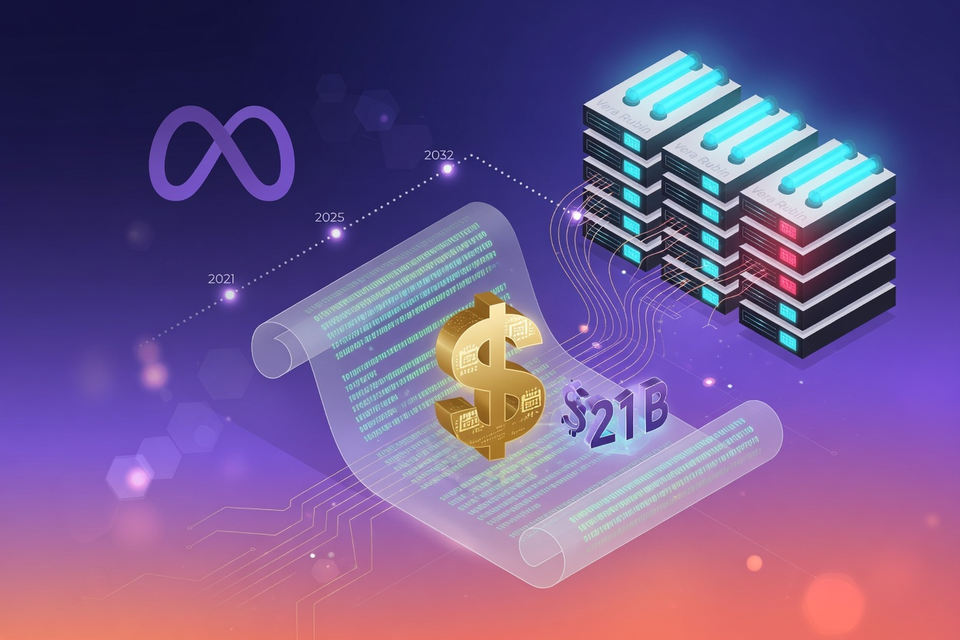
CoreWeave has agreed to supply Meta with roughly $21 billion of AI cloud capacity running through December 2032, and some of that capacity will arrive as early deployments of Nvidia's Vera Rubin platform.
Strip the vocabulary away and the arrangement is simpler than it sounds. Meta is not buying machines here. It is renting them at industrial scale from a company that owns the buildings, the power contracts and the accelerators sitting inside.
The deal builds on a contract the two signed in September 2025, worth $14.2 billion and running to December 2031. Data Center Dynamics reports that Bloomberg had already put that older contract $5 billion higher by the time CoreWeave secured an $8.5 billion delayed draw loan in late March for GPU servers and related infrastructure.
Most of the new capacity is aimed at inference, according to CoreWeave's announcement. Think of training as the years a model spends in medical school and inference as the half minute a doctor spends looking at a rash. One is expensive and occasional. The other is cheap per unit, never stops, and quietly becomes the bigger line item.
The capacity will be spread across multiple sites rather than concentrated in one campus, which CoreWeave says is meant to help performance, resilience and scalability. Spreading inference around also puts answers closer to the people asking for them, and latency is the one thing a chat interface cannot hide.
"This is another example that leading companies are choosing CoreWeave's AI cloud to run their most demanding workloads," said Michael Intrator, co-founder, chief executive and chairman of CoreWeave. Read past the confidence and the interesting word is another. CoreWeave's pitch to investors rests on the length of its contracted backlog, not on any single quarter, and a customer of Meta's size extending to 2032 is the sort of thing that backlog is made of.
Paying for the hardware is its own project. Alongside the contract, CoreWeave is raising $4.25 billion through a private offering to qualified institutional buyers, split between $1.25 billion of senior notes due 2031 and $3 billion of convertible senior notes due 2032, per Data Center Dynamics. The same report counts $1 billion in financing from Morgan Stanley, the $8.5 billion loan for GPU purchases and $2 billion of investment from Nvidia already secured this year.
Meta, meanwhile, is not putting everything in one basket. In March it signed an agreement with European neocloud Nebius that could reach $27 billion and would also include Vera Rubin deployments. Two contracts above $20 billion inside a single month is a clear statement about how Meta intends to get compute, which is to say by signing for it rather than pouring concrete for all of it.
Renting has obvious appeal. Capacity arrives on someone else's construction schedule, and the capital sits on someone else's balance sheet. The trade is that Meta ends up holding contracts rather than assets, and contracts do not appreciate when the thing they cover turns out to be scarce.
Whether that proves cheaper by 2032 depends on where accelerator prices and power costs settle, and nobody selling either is offering a fixed answer.


Leave a Reply