
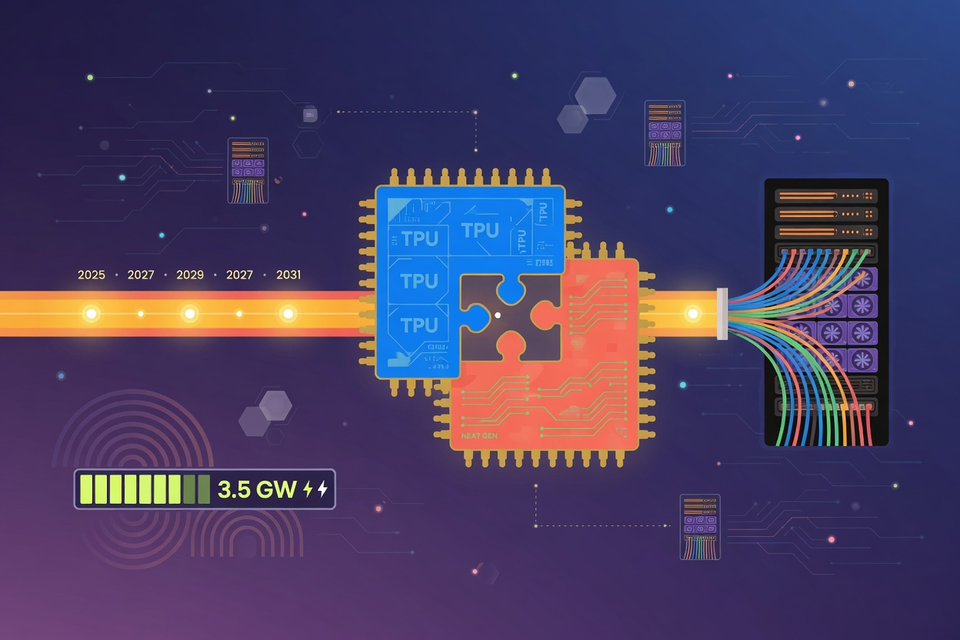
Broadcom has told securities regulators that it will develop and supply the next several generations of Google's tensor processing units, along with the networking parts that turn those chips into complete AI racks, under agreements running as far out as 2031. Financial terms were not disclosed, which is precisely the detail everyone trying to size the deal wanted.
A tensor processing unit, TPU said letter by letter, is a chip Google designed to do one job rather than many. Picture a general purpose graphics processor as a restaurant kitchen that can cook anything on the menu, and a TPU as a place that makes a single dish, all day, very fast. The narrow kitchen wins when the order never changes, and for training and running large models the order really does not change.
The filing describes two contracts rather than one. A long term agreement covers development and supply of custom TPUs for Google's future generations, and a separate supply assurance agreement covers networking and other components for Google's next generation AI racks, through up to 2031. That second half carries more weight than it looks, because at rack scale the interconnect tends to give out before the arithmetic does.
Anthropic turns up in the same document. Beginning in 2027 the AI company will reach roughly 3.5 gigawatts of TPU based compute capacity through Broadcom, part of a larger multi gigawatt commitment it announced on its own account.
Gigawatts, not chip counts, is how this industry now measures itself. It is a faintly absurd unit for computing, a bit like describing a library by its electricity bill, and it is also the honest one, because power and the land to put it on are harder to secure than wafers.
Anthropic's own announcement supplies the demand side of the arithmetic. Run rate revenue has passed $30 billion, up from about $9 billion at the end of 2025, and the count of business customers each spending more than $1 million a year has gone past 1,000, roughly double the figure from two months earlier. "We are making our most significant compute commitment to date to keep pace with our unprecedented growth," said Krishna Rao, chief financial officer of Anthropic.
Then comes the sentence worth rereading. Broadcom's filing states that "The consumption of such expanded AI compute capacity by Anthropic is dependent on Anthropic's continued commercial success." Out of filing English, that means the capacity is reserved rather than certain to be consumed, and the risk of the gap between those two things has to sit on somebody's balance sheet.
Whose is not settled. The same filing notes that "the parties are in discussions with certain operational and financial partners," which is how a company says it has not yet decided who builds the buildings or writes the cheques.
The strategic prize for Broadcom is easier to read. Custom accelerators have become the main alternative to Nvidia's graphics processors for heavy AI work, and Reuters reports that demand for them has surged as buyers look for something other than Nvidia's pricing, with TPU sales growing into a load bearing part of Google's cloud business.
Most of the new capacity will sit in the United States, Anthropic says, extending a $50 billion commitment to American computing infrastructure it made in November 2025. Amazon remains its primary cloud provider and training partner, and Claude still runs across Trainium, TPUs and Nvidia GPUs depending on the workload. Broadcom shares rose about 3 percent in extended trading, so the market got through the filing rather faster than the rest of us.

Leave a Reply