
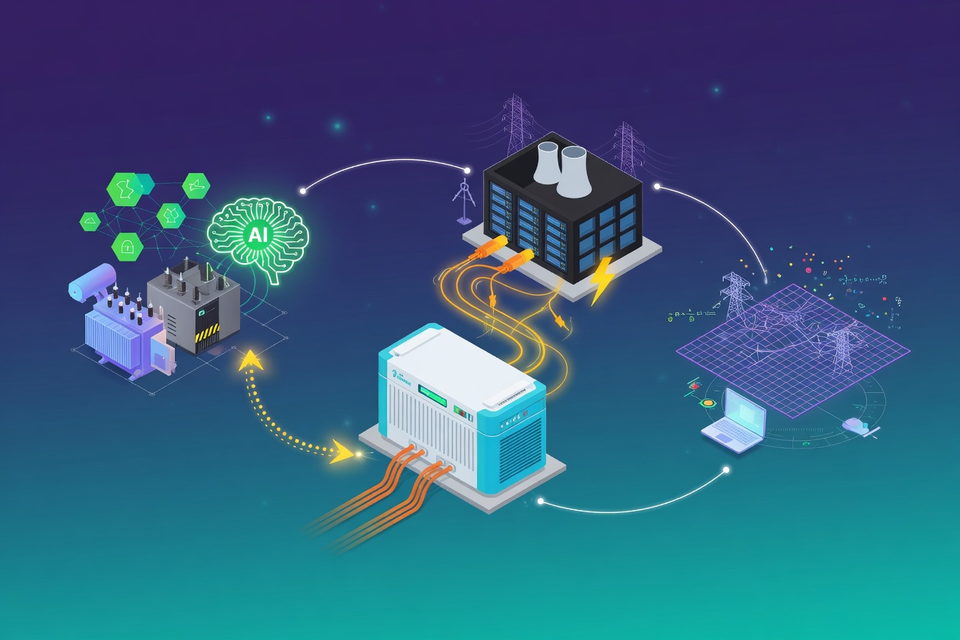
Siemens has widened its data center partner list with three separate arrangements aimed at the same bottleneck, which is getting power to a site rather than getting compute into it. The company has made a strategic investment in and partnership with Emerald AI, added Fluence battery energy storage to its portfolio, and begun a modelling collaboration with PhysicsX. None of the three carries a disclosed value.
Emerald AI is the piece that changes what a data center looks like to a utility. Its software shifts AI workloads in time and location to match grid conditions, coordinating when and where training or inference runs while dispatching onsite energy resources. Siemens says the effect is to smooth peak demand, win faster and larger grid connections, and take pressure off constrained power infrastructure.
"Scaling AI infrastructure isn’t just a computing challenge, it is equally an energy and infrastructure challenge," Gratzke said. Ruth Gratzke is president of Siemens Smart Infrastructure U.S.
Fluence brings grid-scale storage to the same problem from the supply side. By shaping load and coordinating ramp rates, the batteries are meant to make a large AI-scale demand more predictable and therefore easier for a utility to approve, which Siemens argues can turn a power-constrained location into a viable site. The company puts the acceleration at deployment in months rather than years of grid upgrades, and adds that the storage can supply dispatchable onsite power during grid build-outs, capacity shortfalls or outages.
PhysicsX addresses a narrower engineering task. Siemens is applying physics AI to the design of data center power distribution, using models trained on its own multi-physics simulation data to predict thermal behaviour in busway systems. Simulations that once took days can run in under a second, according to the company, which it presents as the basis for faster design iteration and predictive monitoring across a facility.
Gratzke framed the constraint in grid terms: "As demand for AI processing accelerates, data center growth is increasingly constrained by grid capacity and interconnection timelines."
Every performance characterisation here belongs to Siemens. The announcement names no customer, no pilot site and no third party that measured the months-versus-years claim or the sub-second simulation figure, and it sets out no pricing or availability dates for the Fluence integration. Fluence Energy trades on Nasdaq as FLNC; Emerald AI and PhysicsX are private, and the size of the Emerald AI stake is not stated.
For a buyer, the practical question is whether workload flexibility can be written into an interconnection agreement, because that is where a faster queue position would actually be won or lost. Until Siemens names an operator that has done it, the ecosystem is a design intent rather than a delivery record.

Leave a Reply