
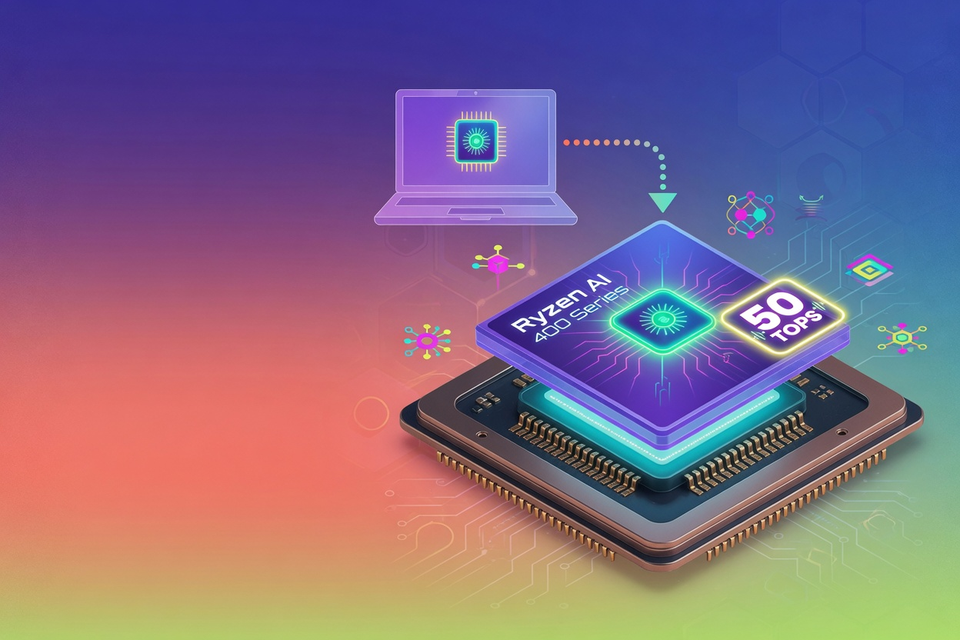
AMD has taken the neural processing unit it has been shipping in laptops and dropped it into the AM5 desktop socket, launching the Ryzen AI 400 Series and Ryzen AI PRO 400 Series desktop processors at Mobile World Congress 2026 with an engine the company rates at up to 50 TOPS.
Two acronyms, both worth a moment. NPU is said letter by letter, and it is a slab of silicon doing one kind of arithmetic, the multiply-and-add that neural networks are built from, and does nothing else. Think of it as the dishwasher in a kitchen. A chef can scrub plates, and a CPU can run a model, but the appliance built for the chore gets through far more for far less effort.
TOPS, said as a word, counts trillions of those operations every second. The company's own endnote is blunt about what that number is worth, describing it as "the maximum number of operations per second that can be executed in an optimal scenario and may not be typical." Treat it as a ceiling rather than a promise.
Twelve parts arrive together. The Ryzen AI 7 models carry eight cores and sixteen threads with 24MB of total cache, the Ryzen AI 5 models six cores and twelve threads with either 22MB or 14MB, and all of them pair Zen 5 cores with RDNA 3.5 graphics and an XDNA 2 neural engine. Boost clocks reach 5.1 GHz at the top of the range. The G models draw 65W, the GE models 35W, and the PRO versions of each are the ones sold into managed corporate fleets. Systems are expected in the second quarter of 2026 from HP and Lenovo.
Whether this counts as a desktop first depends on how narrowly the category is drawn, and the release draws it narrowly: these are the first desktop processors supporting Microsoft Copilot+ experiences, a claim about a Microsoft feature threshold rather than about desktop NPUs generally. No rival desktop chip is named anywhere in the announcement.
The one published benchmark figure belongs somewhere else entirely. A summary bullet says Ryzen AI 400 Series mobile processors deliver up to 30 percent faster multithreaded performance than competitive processors, plural. Follow the footnote and the plural collapses into one comparison, a Ryzen AI 9 HX PRO 470 in an HP EliteBook at 28W against one Intel part in a Dell XPS 14 at 25W. The Intel machine had faster memory, 9600MHz against 8533MHz. The endnote lists Cinebench 2026 single core, Blender, a single thread test and an nT test, then explains only how the single core scores were chosen, and never says which test produced the multithreaded number.
A smaller oddity sits in the same passage. AMD's prose names the compared part the Intel Core Ultra X7 3581. Its own configuration endnote, describing the same test, names an Intel Core Ultra X7 358H. The release does not reconcile the two.
"The desktop PC is evolving from a tool you use to an intelligent assistant that works alongside you," said Jack Huynh, senior vice president and general manager of the Computing and Graphics Group at AMD.
The interesting question is what those desktops actually run. AMD lists AI assistants and productivity tools, and notes that keeping the model on the machine keeps the data there too, which matters to an IT department answering for where company documents go. What it does not offer is a workload that needed a desktop NPU and could not wait. Silicon has arrived ahead of the software again, and the software has a quarter to catch up.


Leave a Reply