
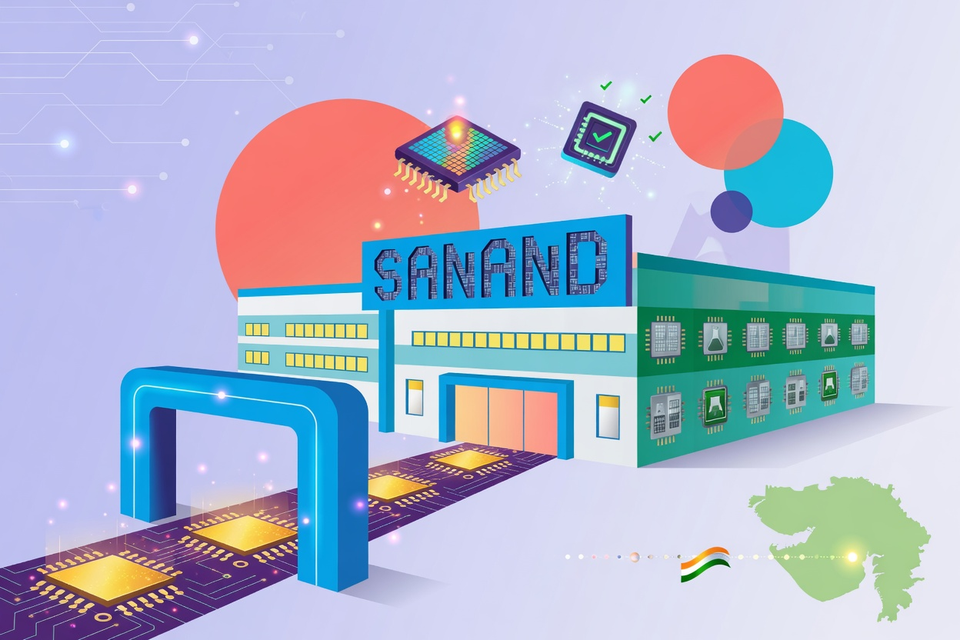
Micron has opened India's first semiconductor assembly and test facility, at Sanand in Gujarat, and says the site is already in commercial production.
This is a back-end plant, not a fab. Sanand takes DRAM and NAND wafers from Micron's existing manufacturing network and converts them into finished memory and storage products. No lithography, no wafer starts, and no new bit supply comes out of Gujarat.
The money is a combined figure. Micron puts the investment at approximately $2.75 billion across itself and its government partners, without breaking out the split. Once the first phase is fully ramped the site is to carry more than 500,000 square feet of cleanroom, which the company calls one of the world's largest single-floor assembly and test cleanrooms, a superlative narrow enough to be defensible and loose enough to be untestable.
Output is given in units, not bits. Micron expects to assemble and test tens of millions of chips at Sanand in 2026, scaling to hundreds of millions in 2027. A unit is not a bit, and the release gives no product mix, so neither figure converts into capacity comparable with the company's other back-end sites. Nor does it name which fabs feed Sanand.
"Today is a proud moment for Micron and India's growing semiconductor industry," said Sanjay Mehrotra, Chairman, President and CEO of Micron Technology. The commercially interesting part sits underneath that. The site's first act was handing Dell Technologies a shipment of made-in-India memory modules for laptops built in India for India, which makes Sanand a domestic-content asset before it is a capacity asset.
The release is explicit about the division of labour. It describes Sanand as an expansion of conventional assembly and test that complements planned advanced manufacturing and packaging capability in the United States. On that split, the advanced packaging work sits in America and the conventional work sits in India. Micron does not say whether the division is permanent.
Supporting detail is thin but checkable. The site is ISO 9001:2015 certified. Micron says it is designed to meet or exceed LEED Gold and uses water-saving technology to enable zero liquid discharge, and it names Pandit Deendayal Energy University, Namtech and government-sponsored skills programmes as the workforce pipeline. There is no opening headcount in the release, no phase-two schedule, and no statement that phase two is funded.
Bootnote: the $2.75 billion is a combined number covering Micron and its government partners, so it does not line up against the company's fab capital announcements. Anyone stacking it beside a wafer fab figure is comparing a shared bill for a back-end plant with one company's spend on a front-end one.



Leave a Reply