
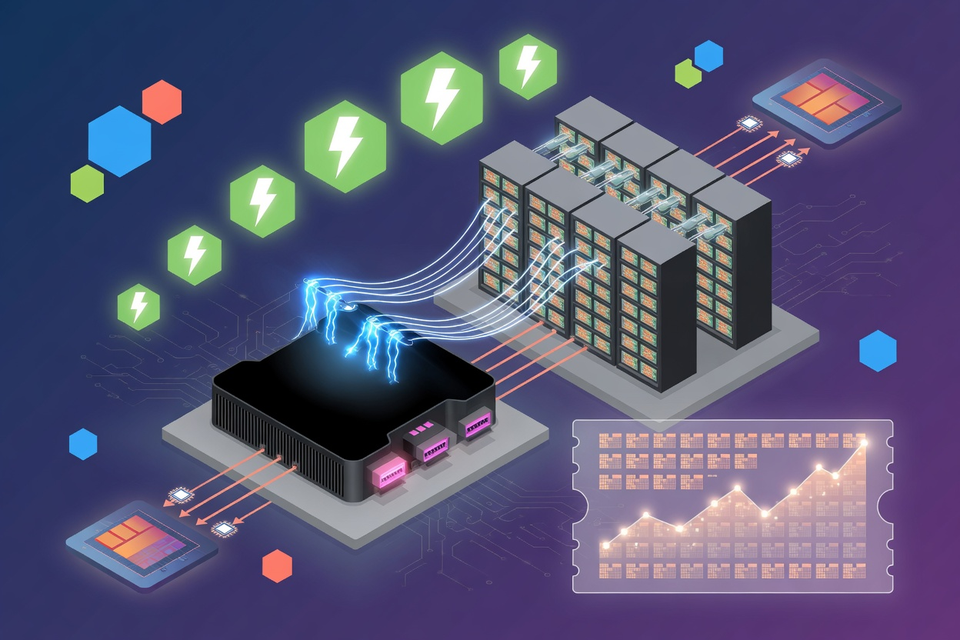
Meta has taken to buying its AI silicon the way a utility buys turbines, and its newest supplier is AMD. The two companies have signed a multi-year agreement covering up to 6 gigawatts of AMD Instinct graphics processors for Meta's data centers, plus AMD server CPUs and a commitment to line up their silicon, systems and software roadmaps.
Six gigawatts is not a count of chips. It is the electrical draw of the racks those chips sit in, which is how the largest buyers now measure compute, because power is what they run out of before silicon. Picture roughly six large power stations wired straight into matrix multiplication.
The purchase order is only half of it. AMD has issued Meta a performance-based warrant for up to 160 million AMD shares, about 10 percent of the company, according to CNBC. The first tranche vests when the first gigawatt of Instinct GPUs ships, and further tranches vest as Meta buys its way toward six. Vesting also turns on AMD share price thresholds and on technical and commercial milestones at Meta.
"This is about making the right bets at the right time," AMD chief executive Lisa Su told CNBC. Set that next to the warrant and the shape of the bet gets clearer. AMD is handing a customer equity to get its accelerators into one of the few buildouts large enough to move its numbers, and it has run this play before: a near-identical arrangement with OpenAI, also built on 160 million shares, landed in October.
Shipments supporting the first GPU deployments begin in the second half of 2026, Meta says, on the Helios rack-scale architecture the two firms showed at the Open Compute Project Global Summit. CNBC reports the early units are MI450 parts. Helios is a whole rack rather than a card, which matters because what Meta is really procuring is floor space and a power envelope, not components.
None of this displaces Nvidia. Meta committed to millions of Nvidia processors a week before this agreement, and Nvidia still holds roughly 90 percent of the AI chip market, CNBC reports. What Meta has bought from AMD is a second door into the same warehouse.
Mark Zuckerberg, Meta's founder and chief executive, said in the company's announcement: "This is an important step for Meta as we diversify our compute. I expect AMD to be an important partner for many years to come." Meta files the agreement under a program it calls Meta Compute, sitting alongside its in-house MTIA accelerators, which is a polite way of saying it would rather no single vendor held the keys.
The spending behind that preference is not small. Meta committed to as much as $135 billion in capital expenditure this year and has plans for 30 data centers, 26 of them in the United States, CNBC reports.
Ben Bajarin, a chip analyst at Creative Strategies, put the wider point to CNBC. "Meta is in a unique position to control the full stack and they can use whoever's compute they want," he said. "It's just a punctuation point on the fact that we are compute constrained, and deals will be done across the board."



Leave a Reply