
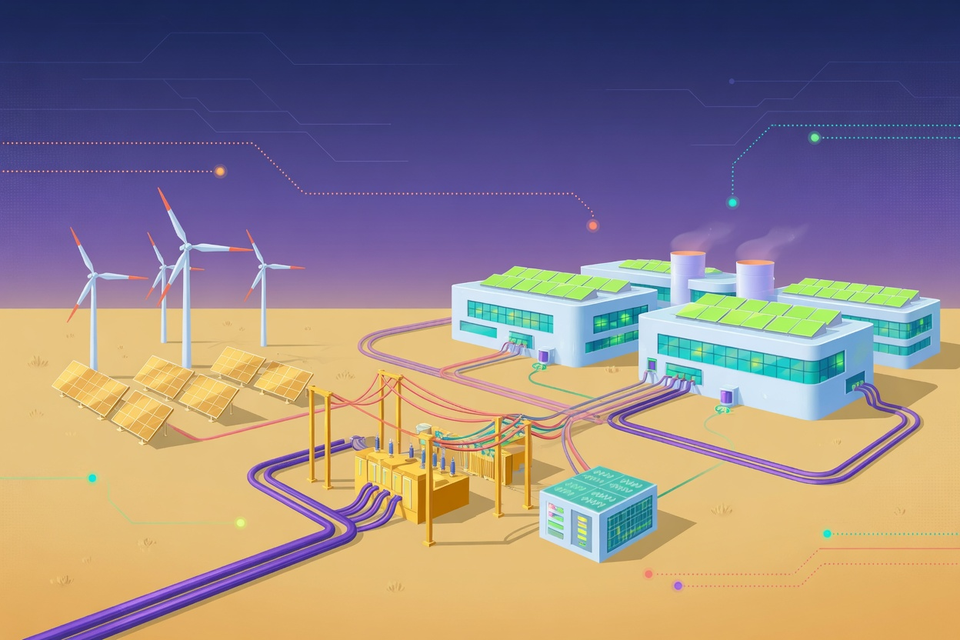
AES has agreed to build, own and operate new electricity generation alongside a Google data center campus in Wilbarger County, Texas, and to sell that output to Google under 20-year power purchase agreements. AES says it secured the land and the interconnection agreements ahead of the deal and will build the shared electrical infrastructure serving both the generation and the campus.
The structure is the news here, more than the site. Instead of taking a grid connection and contracting for supply separately, Google is buying a location that arrives with generation attached to it. AES will also run the campus commercially under a long-term energy management agreement covering retail electricity supply and related services.
"Our expanded partnership with Google demonstrates how AES can accelerate data center development by delivering powered land and energy at scale," said Andrés Gluski, AES President and CEO. What the announcement does not put a number on is the capacity involved. Neither company disclosed the IT load of the Wilbarger County campus, the megawatts under the power purchase agreements, the technology behind the generation described as clean, an investment figure, or a date for first power or first racks.
Those gaps matter for anyone trying to compare this arrangement with a conventional build. A 20-year PPA priced against on-site generation behaves differently from a grid connection plus a merchant contract, and without a capacity figure or a price the two cannot be set side by side. The strain the campus avoids putting on the local network is also unquantified: both companies say co-location reduces it, and neither says by how much.
Cooling is the other design decision that carries a trade-off. KAUZ reports that the campus will be air-cooled, with water consumption limited to critical campus operations such as kitchens, and that Google intends to replenish more water than the site consumes while working with Texan by Nature and Texas Water Trade on watershed projects. Air cooling removes the water question and moves the load onto electricity, and the announcement does not say what the design does to the campus power draw or its PUE, which is the figure a facilities engineer would want before drawing any comparison.
Google has been buying Texas generation for some time. Its announcement, as reported by KAUZ, puts its contracted total at more than 7,800 megawatts of net-new generation and capacity added to the Texas grid through power purchase agreements with developers including AES. The company already runs campuses at Midlothian and Red Oak and has construction under way in Armstrong and Haskell counties. From 2026 it will open applications for a $30 million Energy Impact Fund aimed at energy affordability, efficiency, workforce development and weatherization work in Texas.
For buyers, the deliverable in this deal is a powered site rather than a power contract: land, interconnection and generation packaged together and sold on a 20-year term, with AES retaining the assets and the operating obligation. Whether that packaging is cheaper than a grid connection plus a merchant PPA cannot be judged until one of the two companies publishes a capacity figure and a price.



Leave a Reply