
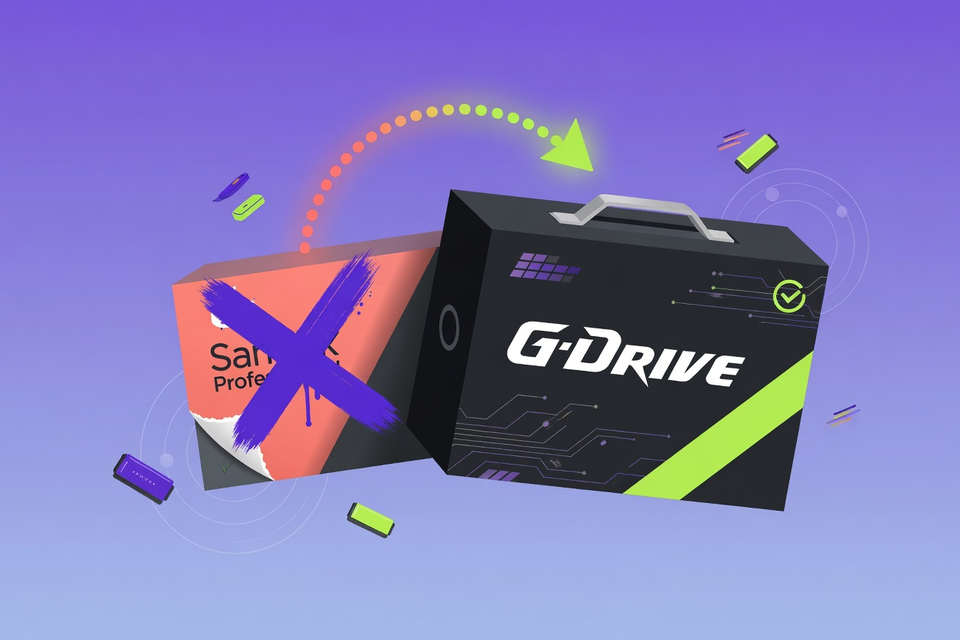
WD is retiring SanDisk Professional branding across its content creator storage line and consolidating the lot under a revived G-DRIVE name, with the transition complete by the end of this month.
Nothing new ships as a result. The release states that products carrying the new branding have already begun shipping, and every drive on the list is one WD already sells. This is a label change with a launch attached to it.
The reason for the change is not in the marketing copy. It is in the trademark boilerplate at the bottom of the release, which states that Sandisk and Sandisk Professional are trademarks of Sandisk Corporation. Western Digital separated into a standalone hard drive company in late February 2025 and the SanDisk marks went with the other side. WD has been selling spinning disk under a brand it no longer owns, and that arrangement had a shelf life.
So look at what is actually in the lineup, because it is instructive. G-DRIVE ArmorATD is a rugged portable to 6TB with IP54 dust and water protection and triple layer shock resistance. The G-DRIVE desktop unit runs an enterprise class Ultrastar to 26TB. G-DRIVE PROJECT is a single bay Thunderbolt 3 box, again Ultrastar, again to 26TB. G-RAID PROJECT 2 is a two bay Thunderbolt 3 unit with field swappable Ultrastar drives to 52TB. G-RAID SHUTTLE 4 and SHUTTLE 8 are four and eight bay transportable arrays with hot swappable Ultrastar drives to 208TB.
Every one of those is a hard drive. WD kept the disk business in the split and the flash went the other way, so the creator portfolio it has left is mechanical from top to bottom, built on Ultrastar, the family WD sells into hyperscale racks. Selling nearline capacity into an editing suite is a reasonable way to fill a fab-free product line, and it explains why the capacity ceilings jump in 26TB steps.
Now read the array numbers against WD's own shipping configurations. The 208TB on SHUTTLE 8 is eight Ultrastar drives at 26TB, and the unit ships in default RAID 5, so the usable figure is seven drives' worth, about 182TB. The 52TB on PROJECT 2 is two 26TB drives and it ships in RAID 0, which is to say a two bay RAID product whose out of box configuration has no redundancy at all. Then apply the release's own asterisk, which defines a terabyte as one trillion bytes.
One more thing worth noticing. Within a single product list WD calls the single bay unit G-DRIVE PROJECT and the two bay unit G-RAID PROJECT 2, which is either a deliberate split between the drive and array sub-brands or a copy desk having a long afternoon.
Existing SanDisk Professional hard drive products keep full support and warranty coverage from WD. The colour portfolio stays too, with WD Gold for enterprise, WD Purple for smart video, WD Red for NAS, WD Blue for PC productivity and WD_BLACK for gaming, all of them hard drive lines.
Bootnote: the release carries no pricing. For a portfolio pitched at working photographers and production studios, where the buying decision is dollars per terabyte against a Thunderbolt bus, that is a conspicuous omission from a document otherwise happy to quote capacities to the drive.




Leave a Reply