
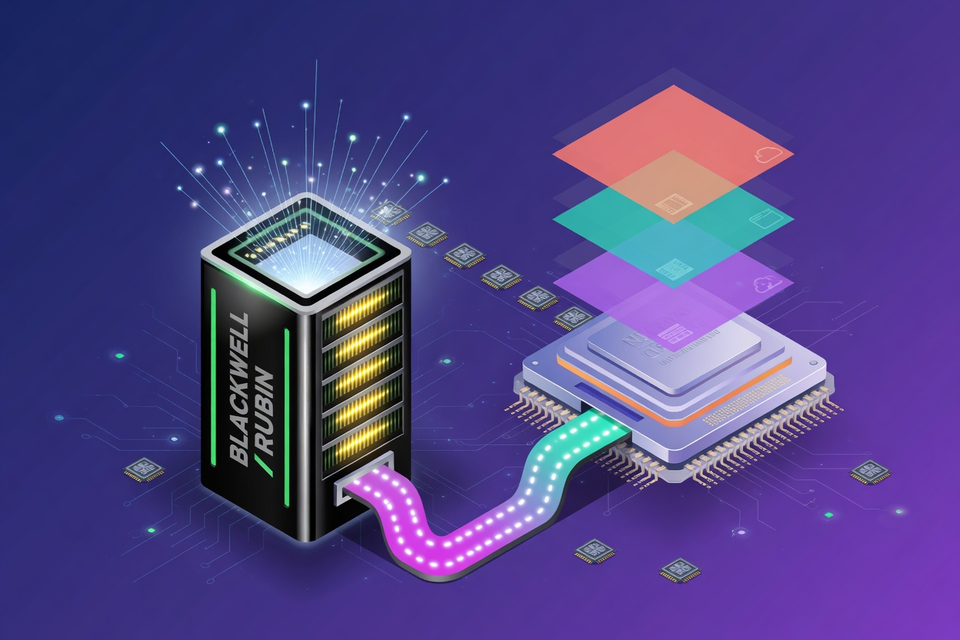
Nvidia has signed Meta to a multiyear, multigenerational partnership spanning on-premises, cloud and AI infrastructure, and the number everyone will repeat is millions of Blackwell and Rubin GPUs. The quieter line in the same announcement is that Meta is buying Nvidia's central processors as well.
That distinction matters more than it sounds. A GPU is the specialist that grinds through the enormous, repetitive arithmetic behind training a model. The CPU is the general manager that decides what happens next, moves data around and keeps everything else fed. Nvidia has owned the specialist chair for years. The manager's chair has mostly belonged to somebody else.
Grace, pronounced exactly as it looks, is Nvidia's Arm-based CPU. The two companies say they are continuing to deploy it for Meta's data center production applications, which is not a test rack in a lab but the machinery that runs the actual service. Nvidia's announcement calls this the first large-scale Grace-only deployment, and credits joint design work and software optimization in CPU ecosystem libraries for improving performance per watt with each generation.
Watts are the real currency in this business. A hyperscale campus is capped by the electricity it can draw and the heat it can reject, so every point of efficiency converts directly into more usable compute behind the same substation. I have watched people argue about clock speeds for an hour and never mention the power bill, which is a bit like comparing sports cars without asking what fuel costs.
Next in the queue is Vera, Nvidia's follow-on CPU. The companies say they are collaborating on deploying it, with the potential for large-scale deployment in 2027. No firm commitment, no volume, no date beyond that year.
Networking comes along too. Meta is adopting Nvidia's Spectrum-X Ethernet platform across its infrastructure footprint, with Spectrum-X switches integrated into the Facebook Open Switching System, the in-house switch software Meta has run on its own hardware for the better part of a decade. Letting a vendor's silicon into that stack is not a small concession.
On the systems side, Meta will deploy GB300-based machines and build a single architecture that stretches across its own halls and Nvidia Cloud Partner deployments, so the same workload does not need rewriting depending on whose building it lands in. Meta has also adopted Nvidia Confidential Computing for WhatsApp private processing, with both companies saying they intend to extend it to other parts of Meta's portfolio.
"We’re excited to expand our partnership with NVIDIA to build leading-edge clusters using their Vera Rubin platform to deliver personal superintelligence to everyone in the world," said Mark Zuckerberg, founder and CEO of Meta. Nvidia founder and chief executive Jensen Huang framed it as codesign across processors, accelerators, networking and software, giving Meta's engineers the whole Nvidia platform rather than parts of it.
What the announcement does not carry is a price, a delivery schedule or a benchmark. Millions of GPUs is a quantity, not a contract value, and the performance-per-watt gains are stated without a figure or a named test. Grace displacing incumbent server processors inside one of the largest fleets on earth is the claim worth watching, and it is the one Nvidia has given the least evidence for so far.



Leave a Reply