
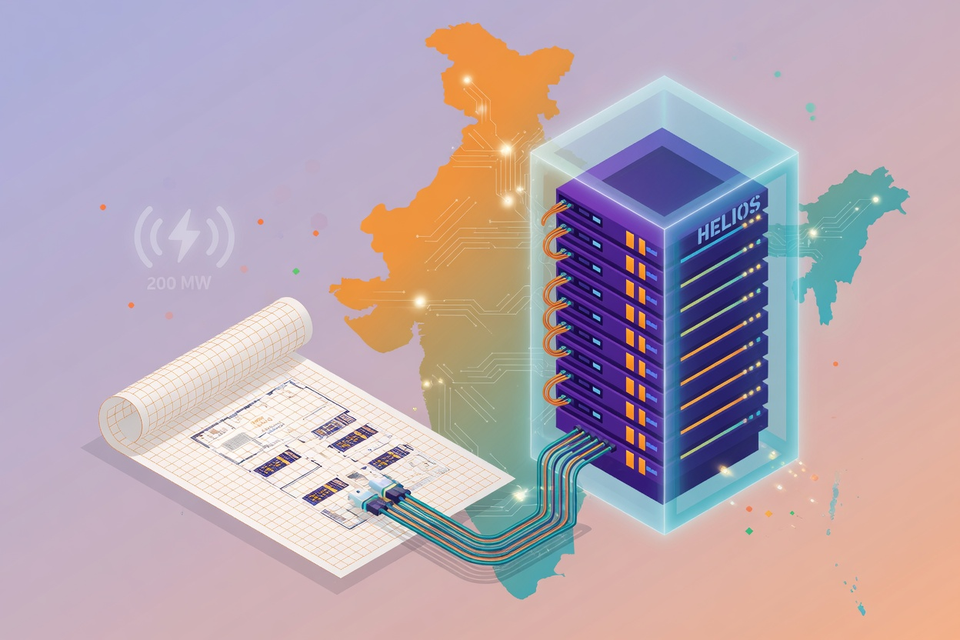
AMD and Tata Consultancy Services have widened an existing partnership to put Helios, AMD's rack-scale AI design, inside Indian data centres, and the number the two attached to it is 200 megawatts. That is the ceiling on an "AI-ready data center blueprint" the companies say they will offer jointly, with the engineering running through HyperVault AI Data Center Limited, a TCS subsidiary set up in 2025.
Rack scale is worth a moment, because it is doing a lot of work in that sentence. A rack is the tall steel cabinet that holds the servers, and for most of computing history the buyer filled it themselves, choosing processors from one company, network cards from another, and hoping the power and cooling maths came out right. Rack scale means the vendor sells the cabinet as one designed object, the way an airline sells a seat rather than a pile of aluminium and upholstery.
Inside this particular cabinet, AMD lists Instinct MI455X GPUs, EPYC processors from the generation it codenames "Venice", Pensando Vulcano network interface cards, and ROCm, its open software stack. ROCm, said as one word to rhyme with "rock 'em", is the layer that translates an AI model into instructions AMD silicon understands. It is also the part of the pitch aimed squarely at Nvidia, whose own software has been the reason many buyers never seriously shopped elsewhere.
What the companies have not said is where any of this goes. No site, no commissioning date, no capital figure, and no named customer appeared in the announcement. A blueprint supporting up to 200 megawatts is a design that scales to 200 megawatts, which is not the same thing as 200 megawatts of concrete, transformers, and signed offtake. AMD describes the EPYC part as next-generation, which is its own quiet timing signal.
HyperVault is the piece to watch. TCS created it last year to build AI-ready capacity at gigawatt scale for hyperscalers, AI companies, and large enterprises, and this collaboration gives it a reference design to sell against. Both companies say they will work with hyperscalers and AI firms to speed up data centre build-outs across India, which is a polite way of saying HyperVault would like to be the landlord.
For AMD the logic is straightforward enough. It has spent the past year trying to convert benchmark wins into deployed racks, and a national-scale partner with 580,000 staff and more than $30 billion in annual revenue is a faster route into a market than a sales office. India is also a place where the phrase "sovereign AI", meaning compute a country controls and hosts itself, carries real procurement weight rather than conference-panel weight.
The bet underneath is that buyers who have watched GPU supply and software lock-in decide their roadmaps will pay something for an open stack and a second supplier. That bet is cheap to state and expensive to prove, and the proof will arrive as megawatts energised rather than as slides. Until a site is named, 200 remains a design limit rather than a delivery.

Leave a Reply